




Single Bars Diode Laser
BrandNew: Your Professional Laser Diode Manufacturer!
Extensive product line
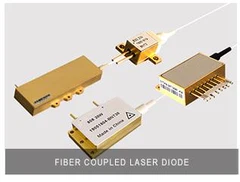
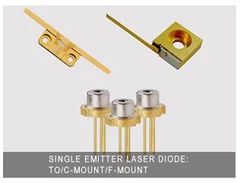
Founded in 2011, Professional Laser diode supplier, manufactures high-power diode lasers and systems in a wide range of output powers and wavelengths including laser chip, fiber coupled laser diode, single bar and high power diode laser array.
Quality Assurance
BrandNew pursues high quality, high efficiency, and high standard testing process to ensure that each product is tested at every level before shipment, and we strive to deliver perfect products to our customers, providing customers with a pleasant shopping experience and usage experience.
Customized Service
BrandNew designing and manufacturing a wide range of configurable and custom laser diode modules for machine vision, medical equipment, security, 3D printing, UV curing, and many other challenging applications.
24H Online Service
BrandNew Company offers 24-hour online support for advanced laser diode solutions. The BrandNew sales team has rich knowledge reserves and can help customers solve problems professionally.


What is Single Bars Diode Laser?

The single bar diode laser includes MCC diode laser bar and CS diode laser bar. MCC Diode Laser Bar refers to a semiconductor laser bar that uses a microchannel cooler (MCC). MCC Laser Bar is mainly used for the packaging structure of high-power semiconductor lasers. Its core feature is efficient heat dissipation performance and the ability to work under high duty cycle continuous wave and quasi-continuous wave. CS packaged diode laser bar refers to a semiconductor laser packaging form, where "CS" stands for conduction cooling. This packaging form is mainly used for high-power semiconductor lasers, especially in high duty cycle and continuous operation mode, which requires an efficient heat dissipation solution.
MCC Bar
CS Bar
Handheld Hair Removal
What are the existing products for single bars diode laser?
MCC Diode Laser Bar
| Wavelength | Item Number | Power | Working Mode | Cooling Method |
| 808nm | MC808DL50 | 50W | CW | Water Cooled |
| MC808DL100 | 100W | CW | Water Cooled | |
| 940nm | MC940DL50 | 50W | CW | Water Cooled |
| MC940DL100 | 100W | CW | Water Cooled | |
| MC940DL200 | 200W | CW | Water Cooled | |
| 960nm | MC960DL200 | 200W | CW | Water Cooled |
| MC960DL500 | 500W | QCW | Water Cooled | |
| 976nm | MC976DL100 | 100W | CW | Water Cooled |
| MC976DL200 | 200W | CW | Water Cooled |
CS Diode Laser Bar, FAC optional
| Wavelength | Item Number | Power | Working Mode | Cooling Method |
| 755nm | CC755DL50 | 50W | CW | Conduction Cooled |
| 808nm | CC808DL20 | 20W | CW | Conduction Cooled |
| CC808DL30 | 30W | CW | Conduction Cooled | |
| CC808DL40 | 40W | CW | Conduction Cooled | |
| CC808DL50 | 50W | CW | Conduction Cooled | |
| CC808DL60 | 60W | CW | Conduction Cooled | |
| CC808DL80 | 80W | CW | Conduction Cooled | |
| CC808DL100 | 100W | CW | Conduction Cooled | |
| CC808DL200 | 200W | QCW | Conduction Cooled | |
| CC808DL250 | 250W | QCW | Conduction Cooled | |
| CC808DL300 | 300W | QCW | Conduction Cooled | |
| CC808DL500 | 500W | QCW | Conduction Cooled | |
| 830nm | CC830DL50 | 50W | CW | Conduction Cooled |
| 880nm | CC880DL40 | 40W | CW | Conduction Cooled |
| CC880DL50 | 50W | CW | Conduction Cooled | |
| CC880DL80 | 80W | CW | Conduction Cooled | |
| 940nm | CC940DL50 | 50W | CW | Conduction Cooled |
| CC940DL80 | 80W | CW | Conduction Cooled | |
| CC940DL100 | 100W | CW | Conduction Cooled | |
| 976nm | CC976DL50 | 50W | CW | Conduction Cooled |
| CC976DL80 | 80W | CW | Conduction Cooled | |
| CC976DL100 | 100W | CW | Conduction Cooled | |
| 1064nm | CC1064DL40 | 40W | CW | Conduction Cooled |
| CC1064DL100 | 100W | QCW | Conduction Cooled | |
| 1470nm | CC1470DL25 | 25W | CW | Conduction Cooled |
| 1550nm | CC1550DL25 | 25W | CW | Conduction Cooled |
| CC1550DL500 | 500W | QCW | Conduction Cooled | |
| 1940nm | CC1940DL10 | 10W | CW | Conduction Cooled |
What is the difference between water cooling and conduction cooling of laser bar?

Cooling mechanism
Water cooling: Laser water cooling is to dissipate heat through water circulation. The water is circulated inside and outside the laser to transfer heat to the water, and then recycled after dissipation in the radiator. Water cooling has high thermal conductivity and heat transfer capabilities, and can transfer heat to the outside faster, thereby ensuring efficient and stable operation of the laser and reducing the failure rate.
Conduction cooling: Conduction cooling usually refers to the use of the thermal conductivity properties of materials such as metals to dissipate heat. This cooling method depends on the thermal conductivity efficiency of the material and is usually used for small devices or local heat dissipation.
Applicable scenarios
Water cooling: Suitable for scenarios that require long-term continuous operation and ensure stability. Water cooling can provide better heat dissipation effect and reduce failure rate. It is suitable for high-power lasers or applications that require high stability.
Conduction cooling: Suitable for small devices or local heat dissipation needs. Since conduction cooling depends on the thermal conductivity efficiency of the material, its heat dissipation effect is relatively limited, and it is suitable for devices with low power or low heat dissipation requirements.
Maintenance cost and difficulty
Water cooling: requires regular replacement of scale filters and addition of coolant, which has high maintenance costs.
Conduction cooling: relatively simple maintenance, requiring only regular cleaning of heat dissipation components, and low maintenance costs.
What is the difference between CW and QCW working modes of laser bar
CW working mode
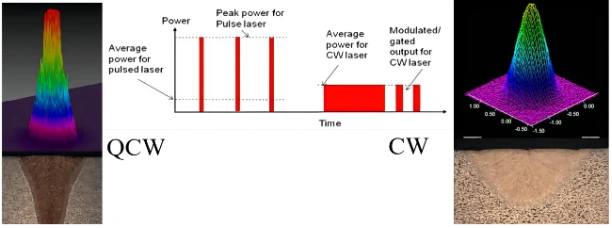
The CW working mode means that the laser operates in a continuous manner, and the energy of the output beam remains constant and uninterrupted. This working mode is suitable for applications that require stable laser energy, such as fiber optic communications and material processing. The output power of CW lasers is relatively low, but it can remain stable, which is suitable for scenarios that require continuous output of laser energy.
QCW working mode
The QCW working mode means that the laser operates in the form of pulses, the duration (width) of each pulse is limited, and there is a certain interval between pulses. QCW lasers usually emit pulses repeatedly at a high frequency, and the pulse width can be modulated as needed to control the output power and pulse energy of the laser. This operating mode is suitable for application scenarios with high requirements for time resolution, such as radar systems and medical equipment. The high-energy short pulses of QCW lasers can provide precise measurement and treatment effects.
Specific application scenarios
CW working mode: Suitable for applications that require stable laser energy, such as fiber optic communications and material processing. In these applications, CW lasers can provide stable output power to meet the continuous needs of signal transmission or material processing.
QCW working mode: Suitable for applications with high requirements for time resolution, such as radar systems and medical equipment. The high-energy short pulses of QCW lasers can provide precise measurement and treatment effects.
What are the differences between CS laser bar and MCC laser bar?
Different cooling methods: CS packaged laser bar adopts passive cooling and usually does not require additional cooling systems such as deionized water and high-pressure pump circulation cooling. Micro channel laser bar adopts liquid cooling, especially microchannel cooler (MCC), whose cooling liquid inlet is located near the laser bar, with high heat dissipation efficiency.
Structural difference: The structure of CS packaged diode bar is relatively simple and may not involve complex cooling channel design. Microchannel diode bar contains microchannel cooler, which is an important part of its structure for effective heat dissipation.
- Maintenance requirements:CS package: maintenance-free design, no microchannel laser diode, no deionized water and high-pressure pump circulation cooling.
- Microchannel laser diode bar: Regular maintenance of cooling system is required.
- Different application scenarios: Due to its maintenance-free and simple cooling method, CS packaged diode bar is very suitable for industrial-grade laser applications.
Microchannel diode bar is more suitable for use in high duty cycle and continuous working mode due to its high heat dissipation efficiency.
What are the functions of CS laser diode bar with FAC lens?
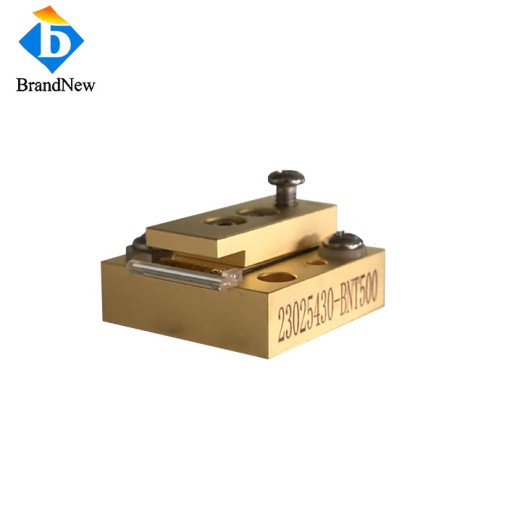
The main functions of the CS laser bar with FAC lens include focusing the light, enhancing the directivity of the beam and reducing the divergence angle of the beam.
The light emitted by a laser bar is already laser light itself, but because it is usually elliptical or coma-shaped when it emerges from the resonator, it requires a lens to focus it. The function of the lens is to focus these rays into a light point, thereby enhancing the directivity of the beam and reducing the divergence angle of the beam.
Focus Light
The lens can effectively focus the light emitted by the laser diode to form a light spot. This focusing effect can significantly increase the projection distance and brightness of light, making the application of laser diodes more efficient and practical.
Enhance the directivity of the beam
By focusing through the lens, the beam emitted by the laser diode can be more concentrated and more directional. This means that the beam can propagate in a specific direction more accurately, reducing the scattering and diffusion of the beam and improving the transmission efficiency of the beam.
Reduce beam divergence angle
The use of lenses can significantly reduce the divergence angle of the beam emitted by the laser diode. The reduced divergence angle means that the beam can maintain a smaller spread during propagation, thereby improving the collimation and stability of the beam.
What are the precautions for using MCC laser bar?
When using water-cooled laser MCC laser bars, pay attention to the following points:
Ensure the correct installation and connection of the water cooling system: including water coolers, water pipes and coolants, check that the connection is firm, and avoid water leakage or seepage.
Choose a suitable coolant: It is recommended to use a liquid with good heat dissipation and anti-corrosion properties, such as distilled water or a coolant mixture, and avoid using liquids that damage the equipment.
Control the temperature of the water cooling system: According to the laser requirements and working environment, adjust the temperature to ensure that the equipment operates at an appropriate temperature. Too high or too low temperature is not good.
Clean the water cooling system regularly: Avoid water pipes, coolers, etc. from being blocked by dirt, which affects the heat dissipation efficiency. Use a soft brush or compressed air for cleaning.
Prevent freezing: In low temperature environment, ensure that the laser and water cooler are always in an environment above 0 degrees Celsius, or keep the laser and water cooler in the power-on state to prevent the water in the pipe from freezing.
Use antifreeze: When the temperature drops below 0℃, use antifreeze for all cooling water; when it is not used for a long time or the power is off, drain the water in the water cooler and store the equipment in an environment above 5℃.
Through the above measures, it can be ensured that the water-cooled MCC laser bar maintains optimal performance and extends its service life during use.
What does a CS laser diode consist of?
CS packaged laser diode components mainly include the following parts:
Laser chip: This is the core part of the laser diode, responsible for emitting laser light. The laser chip is usually composed of a pn junction composed of a p-type semiconductor and an n-type semiconductor, which contains an active layer that emits light and a coating that reflects light.
Metallization layer: The metallization layer is used to connect the laser chip and other components. It is usually divided into an insulating grid, and the cathode and anode are designed on this layer.
Mounting substrate: The mounting substrate is used to fix and support the laser chip and provide heat dissipation. In some cases, the mounting substrate is also used to isolate the heat sink.
Heat dissipation path: In order to ensure that the laser diode does not overheat during operation, there is usually a heat dissipation path design. The heat dissipation path can be vertical or horizontal, depending on the package design
What is the beam smile effect of MCC laser bar?
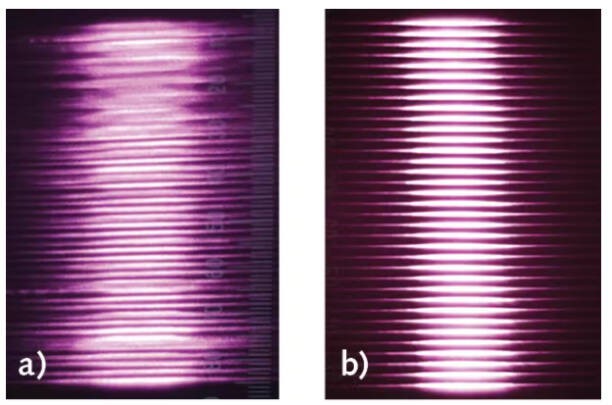
The laser beam smile effect refers to the fact that in a semiconductor laser array (LDA), due to the thermal stress introduced during the packaging process, the laser chip produces light-emitting bending in the fast axis direction, causing the light spots of each light-emitting unit to not be in a straight line. This phenomenon is known as the “smile” effect.
Cause
The main cause of the "smile" effect is the mismatch in thermal expansion coefficient between the laser chip and packaging materials such as substrate heat sink during the packaging process, resulting in thermal stress. This thermal stress is further aggravated when the laser is working, causing the laser chip to bend, thus affecting the linearity of the beam.
Influence
The "smile" effect has a significant impact on beam quality, which is mainly manifested in the deterioration of the linearity of the beam and the uniform distribution of light spots. This will increase the difficulty of beam collimation, shaping and fiber coupling, thereby affecting the overall performance of the laser.
Practical implications and solutions
In practical applications, the "smile" effect will affect the beam quality of high-power semiconductor lasers, especially in applications that require high-precision alignment. In order to reduce the impact of the "smile" effect, it can be improved by optimizing the packaging process, using materials with a more matching thermal expansion coefficient, and considering the impact of temperature changes on beam quality in the design.
What is the principle of CS laser diode application in printing?
The application of CS laser diodes (LD) in printing technology mainly relies on their high efficiency, high power density and precise control. Laser diodes generate lasers through the principle of stimulated emission, which are used to accurately ablate or cure materials during the printing process.
Working principle of laser diodes
The basic structure of a laser diode is a PN junction, which consists of a P-type semiconductor and an N-type semiconductor doped with different impurities. When a forward bias is applied to the PN junction, electrons move from the N region to the P region, and holes move from the P region to the N region. These electrons and holes recombine near the PN junction to generate photons. In order to generate lasers, stimulated emission and optical resonators are also required. Stimulated emission means that when an electron jumps from a higher energy level to a lower energy level, a photon is released. If this photon interacts with another electron at a high energy level, it will cause the electron to also release a photon of the same frequency and phase, thereby achieving light amplification. The optical resonator uses a reflector to reflect photons in the cavity, further increasing the number of photons and eventually forming a laser.
Application of laser diodes in printing technology
In printing technology, laser diodes are mainly used in laser printing. The core component of a laser printer is a laser scanner, which scans the surface of a photosensitive drum with a laser beam generated by a laser diode. When the laser beam irradiates the photosensitive drum, the photoconductive material on the photosensitive drum absorbs the laser energy and forms an electrostatic latent image. Subsequently, the toner is adsorbed onto the electrostatic latent image to complete the printing process.
Can MCC laser diode bars be packaged into laser diode stack?
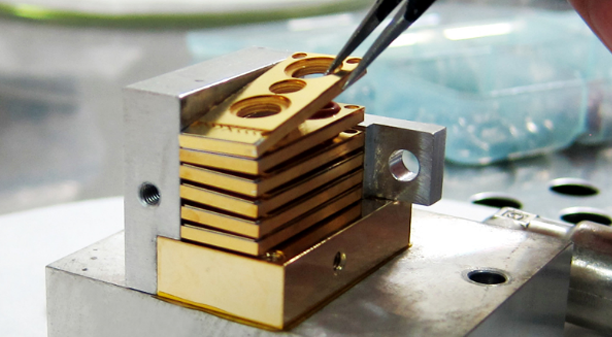
MCC laser diode bars can be packaged into laser diode stack.
MCC laser diode bars can be packaged into laser diode stack by vertical stack (V-stack). Vertical stack semiconductor lasers overcome the beam quality problem of horizontal array lasers, and their beam quality is consistent with that of a single laser beam, which is suitable for applications with high beam quality requirements. In addition, with the improvement of packaging technology, the number of laser bars in a vertically stacked laser can be increased from a few to 70, and the maximum output power can also reach KW.
Packaging structure
The packaging structure of MCC laser diode bars generally includes a cathode, an anode, a coolant inlet and outlet. The coolant inlet of the coolant is close to the anode of the laser array, while the coolant outlet is close to the cathode. This structure enables MCC laser diode bars to effectively dissipate heat and manage heat when stacked in an array.
Application scenarios
After packaging into laser diode stack, MCC laser diode bars can be applied to a variety of high-power laser demand scenarios, such as industrial processing, scientific research, medical equipment, etc. Due to their high power output and good beam quality, MCC laser diode bars can meet the high requirements for laser equipment in these fields after being packaged.
What we can offer in Single Bars Diode Laser?
Single bars diode laser are available in unmounted laser diode bars or mounted in conductively or actively cooled packages. Most diode bars operate in the wavelength region from 755 to 860 nm or between 940 nm and 980 nm. The wavelengths of 808 nm (for pumping neodymium lasers) and 940 nm (for pumping Yb:YAG) are most prominent. Another important wavelength is around 975–980 nm for pumping erbium-doped or ytterbium-doped high-power fiber lasers and amplifiers. A typical passively cooled diode is offered on a CS mount, a standard package that is compatible with a thermoelectric-cooler (TEC) based mounting fixture. The CS mount is appropriate for quasi-CW (QCW) and medium power CW operation. For active water cooling, it use micro-channeled heat sinks. Multiple bars can be stacked in the horizontal or vertical direction to increase the output power.
Applications of Single Bars Diode Laser:
High-power single bars diode laser are directly used (as direct diode lasers) in laser material processing (e.g. laser welding and certain surface treatments) and as medical lasers (e.g. for photodynamic therapy, tattoo removal, laser surgery). Diode bars are also developed further for military use as battlefield laser weapons. For very high powers (above roughly 100 W), one uses diode stacks, which are essential several diode bars stacked in the vertical direction. Another common application is pumping of high-power solid-state lasers – both bulk and fiber lasers.
Features Of Single Bars Diode Lase
AuSn hard solder assembly technology
01
Standard configuration and customer-design package
02
Optimized OE conversion efficiency
03
Available with a fast-axis collimation lens
04
Precautions For The Use Of Laser Diodes
The laser light emitted from this Device is invisible and will harmful to the human eye. Avoid looking directly into the fiber output or into the collimated beam along its optical axis when the device is in operation. Proper laser safety eyewear must be worn during operation.
Absolute Maximum Ratings may be applied to the Device for short period of time only. Exposure to maximum ratings for extended period of time or exposure above one or more max ratings may cause damage or affect the reliability of the Device.
Operating the product outside of its maximum ratings may cause device failure or a safety hazard. Power supplies used with the device must be employed such that the maximum peak optical power cannot be exceeded. A proper heat sink for the Device on thermal radiator is required, sufficient heat dissipation and thermal conductance to the heat sink must be ensured.
The Device is an Open-Heat sink Diode Laser; it may be operated in clean room atmosphere or dust-protected housing only. Operating temperature and relative humidity must be controlled to avoid water condensation on the laser facets. Any contamination or contact of the laser facet must be avoided.
ESD PROTECTION – Electrostatic discharge is the primary cause of unexpected product failure. Take extreme precaution to prevent ESD. Use wrist straps, grounded work surfaces and rigorous antistatic techniques when handling the product.
Order process

Our Certificate

Our Clean Room


Hangzhou Brandnew Technology Co., Ltd. is one of the leading single bars diode laser manufacturers and suppliers in China, has a professional factory which manufacturers high quality single bars diode laser and sells at competitive price. Welcome to wholesale our products made in China.
, CS-Mount LD suppliers , wholesale CS-Mount LD , CS-Mount LD factory , CS-Mount LD China , CS-Mount LD manufacturers China , CS-Mount LD Made in China , Conduction Cooled Diode Laser