


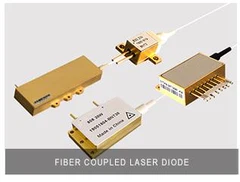
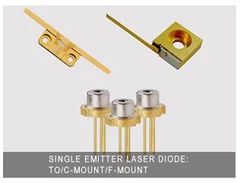


160mW 1310nm High Power Narrow Linewidth DFB Diode Laser Chip
Features
- Single Longitudinal Mode (DFB structure): Stable wavelength emission with low noise
- Compact Chip Design: Ideal for integration into TO-can, butterfly, or custom packaging
- High Reliability: Proven performance for long-term continuous operation
- RoHS Compliant
- Operating case temperature: 0~75℃
Applications:
- Microwave Photonics
- Optical Test and Instrumentation
- FMCW LIDAR
- Optical Sensing

What is Narrow Linewidth?
Great question-this gets right to a core performance metric of DFB chips! Simply put, Narrow Linewidth means the laser emits an extremely pure "color" of light, with an ultra-tight range of wavelengths-no extra stray signals to cause interference.
To make it even clearer, I'll break it down into three parts: what it is, why it matters, and its real-world value-all tied to the 1310nm DFB chip's key use cases.
1. First: What Exactly Is Narrow Linewidth?
Think of laser light as a "color"-different wavelengths correspond to different colors (1310nm, for example, is near-infrared, invisible to the naked eye).
Linewidth: This is the range of wavelengths in the laser beam. A laser with a 10nm linewidth, for instance, would emit light centered at 1310nm, but also include stray wavelengths from 1305nm to 1315nm.
Narrow Linewidth: This compresses that wavelength range to an extremely small size, usually measured in kHz (kilohertz) or MHz (megahertz) (for context: 1nm ≈ 120GHz-narrow linewidth shrinks that 1nm range by hundreds of thousands of times).For a 1310nm DFB chip, narrow linewidth means it consistently outputs only pure 1310nm light-no extra "noise" wavelengths.
2. Why Does Narrow Linewidth Matter For Your Applications?
This directly impacts the 1310nm DFB chip's core uses (like long-haul fiber communications or precision sensing) by solving three critical pain points:
Prevents "signal chaos" in long-distance transmissionIn fiber optics, wide-linewidth lasers suffer from "dispersion"-different wavelengths travel at different speeds in fiber. This blurs or overlaps signals after long distances. Narrow linewidth lasers minimize dispersion, keeping 1310nm signals clear even over hundreds of kilometers-essential for building long-haul telecom networks.
Guarantees accuracy in precision sensingFor applications like lidar or gas detection, systems rely on tiny wavelength changes to measure distance or identify gases. A wide linewidth adds noise, leading to wrong readings (e.g., miscalculating a target's distance). Narrow linewidth keeps the signal "clean," ensuring measurements are precise and reliable.
Reduces interference in multi-channel systemsIn devices with multiple signal channels (e.g., telecom gear transmitting multiple data streams), wide-linewidth laser "stray light" can leak into other channels and disrupt performance. Narrow linewidth eliminates this extra noise, letting the 1310nm chip work smoothly with other components.
3. Bottom Line: Narrow Linewidth Is The "Performance Heart" Of The 1310nm DFB Chip
For anyone using 1310nm wavelengths, choosing a narrow linewidth DFB chip means choosing more stable signals, more accurate measurements, and more reliable system operation. It's not just a technical spec-it's the reason your project meets its goals.

What is DFB Diode Laser Chip?
A DFB Diode Laser Chip (Distributed Feedback Diode Laser Chip) is a tiny, high-performance semiconductor device that generates laser light with exceptional precision-think of it as the "engine" behind many advanced optical systems.
Let's break it down simply:
How it works: Unlike basic lasers that use mirrors to bounce light and amplify it, DFB chips have a built-in "grating"-a tiny, periodic structure etched into the semiconductor material (like a microscopic ruler). This grating acts as a "filter" and "feedback mechanism," selecting one specific wavelength of light to amplify while suppressing others. This is why DFB lasers are famous for their narrow linewidth (super-pure, single-wavelength output) and stability.
Key traits: Thanks to that grating, they produce laser light that's:
Ultra-stable (minimal wavelength drift, even with temperature changes or power fluctuations)
Extremely pure (narrow linewidth, as we discussed earlier)
Tunable (many can adjust their output wavelength slightly for precise matching to specific applications).
Where it's used: You'll find these chips in critical tech like long-haul fiber optic communications (keeping data signals sharp over thousands of km), medical diagnostics (precise spectroscopy), environmental sensing (detecting trace gases), and advanced laser systems.
