


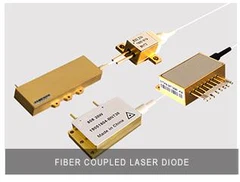
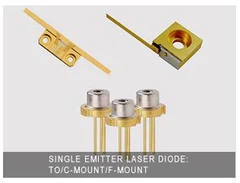


Technological advances have enabled lasers to enter a diverse range of markets from specialized technical instruments. Laser diodes are the most widely used laser technology and are simple semiconductor devices. Over the past 30 years, the average power of laser diodes has increased significantly, while the average price per watt has declined exponentially. As a result, laser diodes are replacing some of the existing laser and non-laser technologies, while also enabling new optical technologies. Mature applications for laser diodes include data storage, data communications, and optical pumping of solid-state lasers. In contrast, material processing and optical sensing are examples of the rapid development of market segments in which many emerging applications emerge.
The output power of a single laser diode varies from milliwatts to several watts. Power can be increased by combining a single emitter into a laser diode bar and a number of bars; a standard bar has a width of 1 cm. For decades, companies have been fiercely competing to increase the output power of diode bars, and have shown an exponential growth trend. Although in commercial diode bar products, the power of each diode bar is typically less than 200 watts at 1 micron wavelength, the R&D department of laser manufacturing companies has demonstrated the average of continuous wave (CW). Power exceeds 1 kW/bar. The increase in diode bar power has made new applications in the field of material processing possible, but some emerging applications require increased laser parameters such as wavelength stability and device lifetime. Therefore, power competition is no longer a top priority for companies in this market. The continued development of diode laser technology is reflected in the improvement of infrared beam quality for precision engineering and the development of new visible light lasers for metal processing.
Continuous wave (CW) laser diode bar power development process
Based on the data collected and analyzed by IDTechEx, the development process of the laser diode bar output power at 1 micron infrared wavelength was studied, as shown in the figure above. The increase in diode bar power has facilitated the development of direct diode lasers and made new applications in material processing possible. The continued development of diode laser technology is reflected in the improvement of infrared beam quality for precision engineering and the development of new visible light lasers for metal processing.