


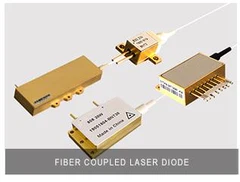
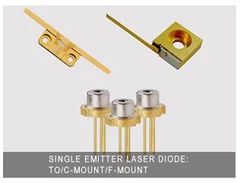


Laser diodes include single heterojunction (SH), double heterojunction (DH) and quantum well (QW) laser diodes. The quantum well laser diode has the advantages of low threshold current and high output power. Compared with the laser, the laser diode has the advantages of high efficiency, small size, long life, but its output power is small (generally less than 2mW), poor linearity, monochromaticity is not very good, so its application in the cable TV system is greatly limited, can not transmit multi-channel, high-performance analog signal. The quantum well laser diode is generally used as the light source in the backpropagation module of bidirectional optical receiver.The working principle ofThe crystal diode is a p-n junction formed by p-type semiconductor and n-type semiconductor, which forms a space charge layer on both sides of its interface and has a self-built electric field. When there is no applied voltage, the diffusion current caused by the difference of carrier concentration on both sides of p-n junction is equal to the drift current caused by the self-built electric field and is in an electrical equilibrium state.When there is a positive voltage bias, the positive current is caused by the increase of carrier diffusion current due to the mutual inhibition of external electric field and self-built electric field.When there is a reverse voltage bias, the external electric field and self-built electric field are further strengthened to form the reverse saturation current I0 which is independent of the reverse bias voltage value within a certain range of reverse voltage.When the applied reverse voltage reaches a certain level, the electric field intensity in the space charge layer of p-n junction reaches a critical value and produces a multiplication process of carriers, a large number of electron hole pairs and a large reverse breakdown current, which is called diode breakdown phenomenon.

How Laser Diodes Work
Aug 13, 2019
Leave a message