


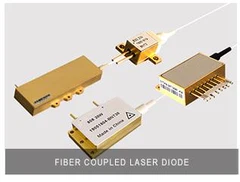


what does laser diode mean?
LASER is a kind of light source invented in the 1960s.LASER is an acronym for "stimulated emission of light amplification" in English.There are many kinds of lasers, which are large to a few football fields and small to a grain of rice or salt.The gas laser has helium-neon laser and argon laser;A solid-state laser has a ruby laser;Semiconductor lasers have laser diodes, such as those in CD players, DVD players and cd-roms.Each laser has its own unique method of producing laser light.Lasers have many properties: first, lasers are monochrome, or single-frequency.There are lasers that can produce different frequencies at the same time, but these lasers are isolated and used separately.Second, lasers are coherent light.The characteristic of coherent light is that all of its light waves are synchronized, and the whole beam is like a "wave train".Again, the laser is highly concentrated, which means that it has to go a long way before it can be dispersed or convergent.
The stimulated emission of semiconductor devices is realized by the injection of PN junction.It has the characteristics of semiconductor devices: small volume, simple structure, high efficiency and direct modulation, but output power, monochromicity and direction are not as good as other lasers.
The three components of the stimulated emission are: laser material, particle number inversion distribution and resonant cavity.Only direct bandgap semiconductor materials can make laser diode, including Ⅲ - Ⅴ compound semiconductor (GaAs, InP, etc.) and its three yuan, four yuan solid solution (Ga1 xAlxAs, In1 - xGaxAs1 yPy, etc.), Ⅳ - Ⅵ compound solid solution (Pb1 - xSnxTe, etc.).After the single crystal direction, cutting and polishing, the PN junction is made on a certain crystal surface such as (001) by diffusion or various epitaxial methods or chemical vapor deposition methods.
In the autumn of 1962, the homojunction GaAs laser diode of the pulsed pulse under 77K was first developed.In 1964 its working temperature was raised to room temperature.In 1969, a single heterojunction laser diode, which produced pulses at room temperature, was made in 1970 to make a continuous work of ga1-xalxas/GaAs double heterojunction (DH) laser diode.Since then, laser diode has developed rapidly.The life expectancy of Ga1-xAlxAs/GaAsDH laser diode increased to more than 105 hours in 1975.The in1-xgaxas1-ypy/InP long wavelength DH laser diode also made significant progress, thus promoting the development of optical fiber communication and other applications.Also appeared by Pb1 xSnxTe Ⅳ - Ⅵ clan materials such as far infrared wavelength laser diode.
In the direction of PN junction, there are homogeneous knot, single heterostructure, double heterogeneity, respectively limit, large cavity and so on.Do the bar in the PN junction plane structure (e.g., electrode bar, flat bar, protons into bar bar, bar groove substrate, steps, buried horizontal bar, bar, compression bar, etc.);The resonator is in the form of fabry-perot cavity, distribution feedback and Bragg reflection.With different semiconductor heterostructure lattice mismatch, use them in the forbidden band width and the difference of refractive index, can get almost entirely in the vertical direction of the p-n junction of carrier limiting and optical limiting.A variety of bars parallel to the direction of the junction can focus the current on a narrow area and provide a gain waveguide or refractive index waveguide.These structural improvements have greatly improved the performance of the laser diode.
Laser diode is essentially a semiconductor diode, according to the p-n junction is the same material, can be divided into homogeneous the laser diode junction, single heterojunction (SH), double heterostructure (DH) and quantum well ('ve) laser diode.Quantum well laser diode has the advantage of low threshold current and high output power, which is the mainstream product of current market application.
Compared with laser, laser diode has advantages of high efficiency, small volume, long service life, but its output power is small (typically less than 2 mw), linear, poor monochromaticity, very good, make it is limited in the application of cable TV system, cannot transmit multi-channel, high performance analog signals.In the echo module of bidirectional optical receiver, a quantum well laser diode is used as the light source.
The structure of the laser diode
The structure and symbol of the laser diode are shown in figure 1.
Physical structure of laser diode is in the light emitting diode junction placed a layer of light between the activity of semiconductor and its end after polishing has partially reflecting function, thus forming an optical resonator.In the case of positive bias, LED DE facto radiates light to and interact with optical cavity, thus further incentives single wavelength of light that is emitted from the junction physical properties related to the material of this kind of light.
The working principle of semiconductor laser diode is theoretically the same as the gas laser.Figure 1(b) is the symbol of the laser diode.The laser diode is used in the optical disk drive of the computer, and the printing of the first class small power photoelectric device in the laser printer has been widely used.

Laser diode structure diagrams and symbols
Simple principle of laser diode
Light emission in semiconductors usually arises from the compound of carrier.When added with positive voltage semiconductor PN junction, weaken the p-n junction barrier, forcing electrons from injection P N area by the PN junction area, hole from P area into N after PN junction area, near the injection of p-n junction non-equilibrium electrons and holes will happen compound, thereby emitting wavelength for lambda photons, its formula is as follows:
Lambda = hc/Eg (1)
In the formula: h - Planck constant;C -- the speed of light;Eg - the band width of a semiconductor.
This phenomenon is called spontaneous radiation due to the spontaneous recombination of electrons and holes.When photons produced by spontaneous radiation through semiconductor, once after the launch of the electronic - hole nearby, has can motivate the compound, to generate new photons, the photon induced has inspired carrier compound and a new photon is called stimulated radiation.If the injection current is large enough, the carrier distribution, which is the opposite of the thermal equilibrium state, is the inverse of the number of particles.As carrier of the active layer in the case of a large number of inversion, a small amount of photons produced by the spontaneous radiation induced by two transverse reciprocating reflection cavity radiation, frequency selective resonance caused by the positive feedback, or has a gain on a certain frequency.When the gain is greater than the absorption loss, the coherent light from the PN junction can be emitted with a good spectral line - laser, which is the simple principle of the laser diode.


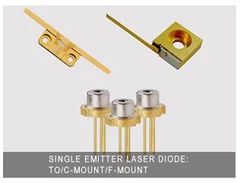
With the development of technology, the current used semiconductor laser diode has complex multi-layer structure.Figure 2 is the structure of the red light semiconductor laser diode of sanyo company in Japan.FIG. 3 is a small power laser tube section view. It can be seen that the laser chip is attached to the heat sink used for heat dissipation. The PIN photodiode is attached to the lower part of the tube seat near the laser chip.Figure 4 for the appearance of ordinary laser diode, the figure shows, small power laser tube has three pins, this is because the tube also encapsulate a photodiode, working current is used to monitor the laser tube.