


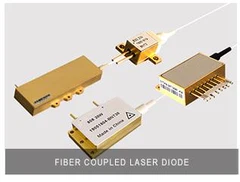
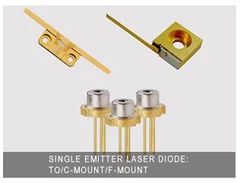


Modern Single Bar Diode Laser Pumped High Power Light Emitting Diode or Diode, Multimode Single Rod, usually through cladding single core around a core. This is usually a 5 to 12 single-mode core diameter μM. Double-clad fiber is doped with rare earth ions such as neodymium, erbium, ytterbium and thulium by inner single-mode core. The cladding is made of doped glass with a low refractive index. The pump light is injected into the cladding and along the structure, passing through the active core and producing the number of particles inversion.
The emission wavelength is selected in the fiber and any type of reflection function (a typical example is Bragg gratings).
The laser consists of a coil of double-clad fiber, two mirrors and a pump source. The pump source can be a single light-emitting diode, a diode bar or a pumped Single Bar Diode Laser
The configuration includes single-mode continuous Single Bar Diode Lasers that can be quickly adjusted to over 100 kHz; Raman frequency shift; Q; multiplier and triple; and quasi-continuous wave (QCW). The output includes UV, visible and near infrared spectroscopy.
The Q-switched Single Bar Diode Lasers are typically made of low power, with an integral pigtail modulator through a series of fiber amplifiers for nanosecond pulsed laser seeds. Fiber amplifiers, such as Single Bar Diode Lasers, are constructed using the same technique; however, the laser does not contain end-induced induced laser effects. These lasers are fully monolithic capable of producing nanosecond pulses from 20 to> 200 kHz.
Raman Single Bar Diode Laser from single-mode Single Bar Diode Laser splicing to the coil single-mode special fiber containing grating, induced Raman frequency shift to the desired wavelength
Pumped Single Bar Diode Lasers
Diode bars can be used to excite Single Bar Diode Lasers. Typically, fiber end-pumped and appropriate bulk optics utilize centralized pump light as the first package for active fiber. Over time, the high power diode bar has a limited deployment of total power improvement, beam performance and lifetime for 10,000 hours or more, although cooling requirements, pulse handling limitations and reliability are limited.
Advantages of single tube pump diodes. The main advantage is that they do not require water to cool, can be introduced into the active medium through the fiber at very high efficiency, no extra bulk optics or need to be adjusted. In addition, a single light emitting diode can produce higher output power and better beam characteristics and greater than 200,000 hours of operating life in continuous wave and modulation mechanisms.
Single - mode Single Bar Diode Lasers
Single-mode Single Bar Diode Lasers are available in the commercial market from a few watts to 3000 watts of output. In addition, single-mode Single Bar Diode Lasers have produced 20 kilowatts of special projects using more expensive fiber technology. These devices are usually continuous in operation; however, the unit can be modulated to more than 50 kHz. In modulation mode, the unit has a peak average power. Through the M single-mode fiber with two less than 1.1. The laser transverse mode is a purely Gaussian distribution.
For example, a 25mm collimator collimates the beam, resulting in a 5mm 1 / E two full of 0.3mrad divergence. With the ytterbium-doped Single Bar Diode Laser, when the last lens is added, the resulting dot is equal to the final focal length divided by the focal length of the collimator 7 times the fiber diameter. With a final focus of 100 mm and a 25 mm collimator lens, the spot size will eventually be 28 [mu] M.
As a configuration file is a function of the single-mode fiber, rather than the hot working point, such as the traditional solid-state lasers, Single Bar Diode Lasers produce the same beam cross section throughout the working range. The modulation is done by rotating the pump diode and completing, allowing the device to be modulated at high frequency or single pulse operation. With the traditional solid-state lasers for Single Bar Diode Lasers, with its perfect cross-section, no warm-up time is required and can be operated over a wide range of stable environmental conditions (power and beam quality). These lasers can be drifted with random linear output, and can usually vary from 10 to 100 percent of rated power without any divergence or any change in the final focus spot diameter.
Kilowatt and above Single Bar Diode Lasers in parallel with the launch through the large diameter fiber optic single-mode Single Bar Diode Laser manufacturing. At this point, the laser is no longer a single mold; however, the resulting beam quality is superior to most commercial industrial kilowatt-class lasers (Figure 3). For example, 8-kilowatt Single Bar Diode Lasers provide a bunch of products less than 4.5 mm x radian from 100 μm-core-diameter step fiber. The disagreement of the kilowatt-class Single Bar Diode Lasers will continue to improve as a result of a sustained high-power single-mode module being utilized. In the near field, the beam profile has a straight edge ratio of Gaussian, providing significant advantages in material processing applications
The latest type of Single Bar Diode Laser is quasi-continuous. These devices have high peak power and lower average power, and can be manufactured at a fairly low cost than the CW version. For example, a 20 kW peak power and an average power of 2 kW quasi-continuous laser is about five times cheaper than a 20 kW CW laser. They are ideal for many industrial applications requiring a long pulse width and peak power, such as spot welding, seam welding and drilling. Designed to replace the existing YAG lasers due to their minimal maintenance and low cost quasi-continuous lasers, can be easily retrofitted to existing systems. Single and multimodal versions are available.