




In the PN junction of some semiconductor materials, when the minority carrier is combined with the majority carrier, the excess energy will be released in the form of light, thus directly converting electrical energy into light energy.The PN junction is added with a reverse voltage, and minority carriers are difficult to inject, so they do not emit light.Such a diode fabricated by the principle of injection electroluminescence is called a light-emitting diode, or LED for short.LEDs are commonly used in the indicator lights of household appliances, anti-fog lamps in automobiles, etc. They have long service life and high photoelectric conversion efficiency.
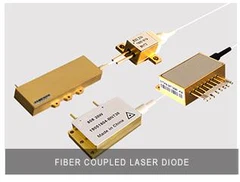
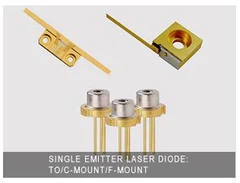
LD is short for laser diode. The physical structure of laser diode is to place a layer of photoactive semiconductor between the junction of led, and its end face has partial reflection function after polishing, thus forming an optical resonator.In the case of forward biasing, the LED junction emits light and interacts with the optical cavity, thereby further exciting the emission of a single wavelength of light from the junction, the physical properties of which are material dependent.The working principle of a semiconductor laser diode is theoretically the same as that of a gas laser. Laser diodes are widely used in CD optical drives on computers, and in low-power optoelectronic devices such as print heads in laser printers.
The difference in principle, architecture and performance
1.The difference in working principle: LED is the spontaneous emission of composite radiation by the carrier injected into the active region, and LD is the combined radiation of stimulated radiation. The direction of the photons emitted by the LEDs is random, and the photons emitted by the LD are in the same direction and in phase.
2.The difference in architecture: LD has an optical cavity, so that the generated photons are oscillated and amplified in the cavity, and the LED has no resonant cavity.
3.Difference in performance: LED has no critical value characteristics, spectral density is several orders of magnitude higher than LD, LED light output power is small, divergence angle is large.
 |  |