




Diode lasers gain more and more importance as tools for applications in welding of plastic and synthetic material.
Using diode lasers for the welding and joining of plastic material enables you (i) to work remotely by attaching a focusing or scanner optic to your laser and hence (ii) to stay versatile concerning the shape of your joint due to the flexibility of your scanner optic and (iii) to be able to process complex geometries in 3D. Furthermore, you can (iv) achieve smaller and more precise joints due to the well-controlled positioning of your laser spot on the material, and (v) increase your energy efficiency due to the superb energy efficiency of the diode laser.

Still, the use of diode lasers leaves you with one challenge: finding the right wavelength for your material combination. Since you are working remotely and not applying heat locally any more, at least one of your plastic partners to join has to absorb the energy of your laser in order to melt and join with the other material partner. Hence, you have to make sure, that the material is responsive to the wavelength you use. Typically, you are facing situations to join (i) transparent plastic on black substrate, (ii) colored plastic on colored plastic substrate, (iii) transparent plastic on transparent plastic substrate and (iv) white plastic on white plastic substrate
The ideal match in wavelength varies from 1064 nm to 1940 nm.
Generally, one can say that joining of transparent plastic to black substrate can be performed best with wavelengths from 808 nm to 980 nm and joining of colored, transparent and white plastics works better with wavelengths in the range of 1064 nm to 1940 nm. Of course, the ideal match in wavelength varies from application to application and should be tested before employing a diode laser.
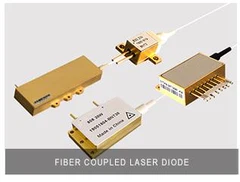
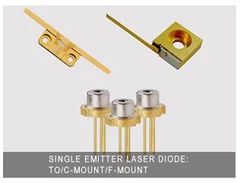
Brandnew can supply 1940nm laser diode for plastic welding. Various packages are available,such as C-Mount, COS, CS, Fiber Coupled...

More information can be check via below link: