


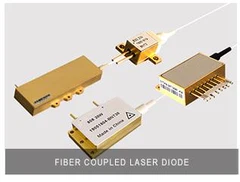
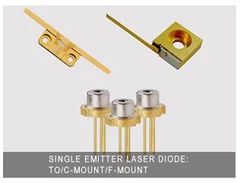


Diode lasers are perhaps the most versatile source of light. While these devices could be customized for almost all optical applications, here we will cover a few of the most common and well-established applications.
Optical Data Transmission
As discussed in a previous article, optical communication is a fundamental technology in the modern world. This method of data transmission allows for wide bandwidths of information to be sent close to the speed of light. Fiber optic systems can send an encoded signal over long distances with minimal loss when driven with the correct light source. Laser diodes operating in the near-infrared are ideal signal beams because of their coherent output. This way, the diode signal enables greater coupling efficiency in the cable and experiences less modal dispersion. They are highly efficient in single-mode fibers for large transmission distances.
Spectroscopy
Spectroscopy was originally limited in examining the interaction of visible light with gases. Due to Doppler broadening, atoms in motion exhibit broadened absorption and emission spectra. Researchers then discovered, however, that they were able to select atoms with zero velocity along one direction with a tunable laser light source. Spectroscopy driven by diode lasers achieves very low detection limits. Diode lasers are now extremely common in spectroscopy because of their narrow bandwidth, easy operation, and high power capabilities.
Medicine
Diode laser benefits a wide variety of medical applications because of their brightness, reliability, and compact size. They are especially prominent in photodynamic therapy (PDT) and non-invasive surgical procedures. PDT treats non-melanoma skin cancer and precancerous conditions by exposing a photosensitizing agent under the skin to visible light. Diode lasers allow for flexibility of spot size, therefore providing target control on the skin.
Pumping Solid-State Lasers
Diode-pumped solid-state lasers (DPSS) are solid-state lasers created by pumping a solid gain medium with a laser diode. This process of “pumping” is how energy transfers into a medium to excite atoms and create a population inversion so that stimulated emission can occur. The gain medium in these lasers is typically a crystal, glass, or fiber. These lasers are able to generate power that ranges from a few milliwatts to multiple kilowatts.