




Classification of lasers
As the core component of all laser application products, lasers are the most important part of all laser application products.And there are many kinds of lasers.Next, the classification of laser working material, incentive mode, operation mode and output wavelength range will be introduced.
According to the classification of work materials, all lasers can be classified into the following categories:
Solid (crystal and glass) laser:
The working substance used by such lasers is made by adding the metal ions that produce the stimulated radiation into the crystalline or glass matrix.
Gas laser:
They work material is adopted by the gas, and according to the real gas produced by the great effect of the different nature of the work of the particles, and further divided into atomic gas laser, ion gas lasers, molecular gas laser and excimer laser gas, etc.;
Liquid laser:
Such laser work adopted by the material mainly includes two kinds, one kind is organic fluorescent dye solution, another kind is inorganic compounds containing rare earth metal ions in solution, which plays a role of working particle metal ions (Nd), while inorganic compounds liquid (such as SeOCl) plays a role of base;
Semiconductor lasers:
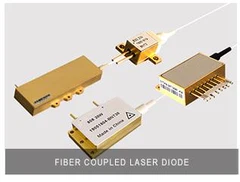
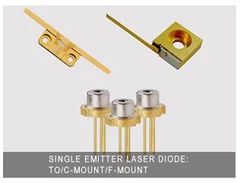
This kind of laser is a semiconductor material role as working substance produced by stimulated emission of radiation, the principle of which is through certain incentives (electric injection, pump light or high energy electron beam injection), between the band gap of semiconductor material or between band and impurity level, by stimulating the carrier and the balance of population inversion, the role of light are produced by stimulated emission of radiation;
Free electron laser:
This is a special type of new type of laser, work material for periodic changes in the space of the high speed motion in magnetic field directional free electron beam, as long as the speed of change of free electron beam can produce tunable coherent electromagnetic radiation, in principle, the coherent radiation spectrum can transition from X-ray wavelengths to microwave area, so it is very tempting prospects.
According to the different wavelength range of the output band, different lasers can be classified as the following.
Far infrared laser:
The output wavelength range is between 25 and 1000 microns, and the laser output of certain molecular gas lasers and free electron lasers falls into this region.
Medium infrared laser:
The laser device with laser wavelength in the middle infrared region (2.5 ~ 25 micron) is represented by the CO molecular gas laser (10.6 micron) and CO molecular gas laser (5 ~ 6 micron).
Near infrared laser:
Refers to the output laser wavelength in near infrared region (0.75 ~ 2.5 microns) of laser devices, representatives for neodymium doped solid state laser (1.06 microns), CaAs semiconductor diode laser (about 0.8 micron) and some gas laser, etc.
Visible laser:
Refers to the output laser wavelength in the visible spectrum area (4000 ~ 7000 or 0.4 ~ 0.7 microns) of laser device, representatives for the ruby laser (6943), he-ne laser (6328), argon ion laser (4880, 5145), krypton ion laser (4762, 5208, 5682, 6471), and some of the tunable dye laser, etc.
Near uv laser:
The output laser wavelength range at the near ultraviolet spectral range (2000 ~ 4000), representatives for molecular nitrogen laser (3371) of xenon fluoride (XeF excimer laser (3511, 3531), krypton fluoride (KrF excimer laser (2490), and some of the tunable dye laser, etc
Vacuum ultraviolet laser; The output laser wavelength range is in the vacuum ultraviolet spectral region (50 ~ 2000 angers) and the (H) molecular laser (H) molecular laser (1644 ~ 1098 et), xenon (Xe) excimer laser (1730 et), etc.
X-ray laser:
The output wavelength is in the X-ray spectrum region (0.01 ~ 50 anges). Currently, the soft X ray has been developed successfully, but it is still in the exploration stage.