

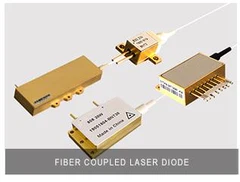
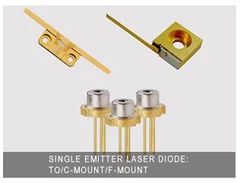


Laser diodes (LD) and photodiodes (PD) differ in their working principles, structures, applications, and characteristics.
1. Working Principle
Laser Diode (LD):
Principle: A Laser Diode is a semiconductor device that emits light through the process of stimulated emission. When electrical current is injected into the diode, electrons and holes recombine in the active region of the semiconductor, emitting photons. These photons stimulate the emission of more photons, and through optical feedback mechanisms (like mirrors or resonant cavities), a coherent light beam (laser) is generated.
Key Characteristics:
Monochromatic: The output light is almost a single wavelength.
Coherent: The emitted light waves maintain a consistent phase relationship.
Directional: The laser beam is highly directional, with a narrow divergence angle.
Photodiode (PD):
Principle: A Photodiode operates based on the photovoltaic effect or photoconductive effect. When light photons hit the semiconductor material (typically at the PN junction), they excite electrons, creating electron-hole pairs. These charge carriers are separated by an internal electric field, generating an electrical current or voltage that is proportional to the light intensity.
Key Characteristics:
Photovoltaic Effect: In zero bias, the light generates a voltage across the photodiode.
Photoconductive Effect: In reverse bias, the photodiode generates a photocurrent that is proportional to the incident light intensity.
2. Function and Applications
Laser Diode (LD):
Function: The main function of a Laser Diode is to emit coherent light (laser), often used in communication systems, sensors, and imaging technologies. By adjusting the electrical current, the output power of the laser diode can be controlled.
Applications:
Optical Communication: Laser diodes are used as light sources in fiber-optic communication systems, where electrical signals are converted into optical signals for long-distance transmission.
Laser Printers: In laser printers, the laser diode scans the image onto the drum to create a charged pattern for toner deposition.
Barcode Scanners: Laser diodes are used in barcode scanners, where the laser beam reads the barcodes by reflecting light off the printed codes.
LiDAR (Light Detection and Ranging): Used in laser rangefinders and mapping systems, where laser pulses are emitted and their reflection times are measured to calculate distances.
Medical Applications: Used in laser surgery, dermatology, and eye treatments for their precision and controlled light output.
Laser Lighting and Displays: Laser diodes are employed in high-precision lighting, display technologies, and laser projectors.
Photodiode (PD):
Function: A Photodiode is designed to detect light and convert it into an electrical signal. It is commonly used in applications requiring the detection and measurement of light intensity, such as in communication systems or light sensors.
Applications:
Optical Communication: Photodiodes are used in optical receivers to detect and convert optical signals back into electrical signals in fiber-optic communication systems.
Spectroscopy: In optical spectroscopy, photodiodes convert light into an electrical signal for analysis of various wavelengths.
Imaging Systems: Used in digital cameras, night vision, and other imaging devices where light is converted into a digital image.
Infrared Detection: Photodiodes are commonly used for detecting infrared light in applications like remote control receivers and IR sensors.
Medical Instruments: In medical applications such as pulse oximeters (measuring blood oxygen levels), photodiodes are used to detect light absorption by blood.
Environmental Monitoring: Photodiodes are used in light sensors for detecting ambient light levels and environmental conditions.
3. Light Output and Response Characteristics
Laser Diode (LD):
Light Output: Laser diodes emit laser light, which has:
Monochromaticity: The light produced by a laser diode is almost a single wavelength, making it ideal for high-precision applications.
Coherence: The emitted light is coherent, meaning the wavefronts are in phase with one another, leading to a stable and focused beam.
Directionality: Laser diodes have a highly directional output with a very small divergence angle, which allows the laser beam to remain focused over long distances.
Brightness: Laser light is much brighter than LED light, as it is highly focused in a narrow beam.
Photodiode (PD):
Light Response: Photodiodes generate an electrical signal (current or voltage) when exposed to light:
Proportionality: The generated current is directly proportional to the incident light intensity, making them suitable for measuring and detecting varying light levels.
Fast Response: Photodiodes have very fast response times, which makes them suitable for high-speed optical communications and fast light detection systems.
Spectral Response: The spectral range of a photodiode depends on the material used. For example, silicon photodiodes typically respond to visible and near-infrared light, while indium gallium arsenide (InGaAs) photodiodes can detect light in the infrared spectrum.
4. Structure and Design
Laser Diode (LD):
Structure: A typical laser diode consists of several semiconductor layers with different bandgaps, which are designed to create an effective light-emitting region (active region). The most common design is a heterostructure where materials with different energy bandgaps are used to control the flow of carriers and promote light emission.
Resonant Cavity: Laser diodes often use a resonant cavity with mirrors or reflecting surfaces at each end to reflect light and amplify it within the device.
Cooling Mechanism: Because of the heat generated during operation, laser diodes typically require a heat sink or active cooling to maintain stable performance.
Photodiode (PD):
Structure: A photodiode typically consists of a PN junction or a PIN structure.
PN Junction: The simplest form of a photodiode, where a P-type and N-type semiconductor are joined. This is common in low-power applications.
PIN Junction: A more advanced structure, where an intrinsic (I) semiconductor layer is sandwiched between the P-type and N-type layers, providing better performance in terms of response time and efficiency, especially in high-speed applications.
Packaging: Photodiodes are usually packaged in TO-can or chip-on-board configurations, depending on the application.
5. Electrical Characteristics
Laser Diode (LD):
Current Characteristics: Laser diodes operate above a threshold current that is required to start emitting laser light. Below this threshold, the diode behaves like an LED, emitting incoherent light. Once the current exceeds the threshold, coherent laser emission begins.
Threshold Current: This is the minimum current at which the laser diode begins to emit coherent light. If the current is too low, the device emits incoherent light; if too high, the diode may overheat.
Voltage Characteristics: Laser diodes typically operate at higher voltages (1.5V to 3.5V) compared to regular LEDs. The voltage is stable once the threshold current is exceeded.
Photodiode (PD):
Current Characteristics: Photodiodes produce a photocurrent that is directly proportional to the intensity of the incident light.
Reverse Bias: In reverse bias, photodiodes exhibit higher sensitivity and faster response times. The photocurrent generated is proportional to the light intensity, and the diode's current is almost constant for a given light intensity.
Zero Bias: Some photodiodes can operate at zero bias, where the photocurrent is generated without an external voltage. This is common in low-power applications.
Voltage Characteristics: Photodiodes often operate in reverse bias to maximize the photocurrent and minimize dark current. The reverse voltage can enhance the speed of response and sensitivity.
Our address
Ruiding Mansion,No.200 Zhenhua Rd,Xihu District,Hangzhou,China
Phone Number
0086 181 5840 0345
info@brandnew-china.com