


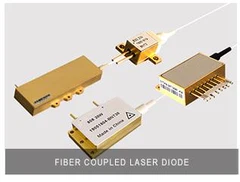
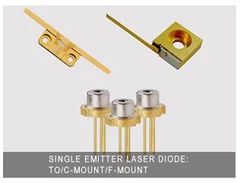


Single Bar Diode Laser are the fastest growing and widely used new lasers in recent years. His development is inseparable from the development of semiconductor lasers. 1960 debut of the first ruby lasers. In 1962 the first homogeneous junction gallium arsenide semiconductor lasers came out. In 1963, Newman first proposed the use of semiconductor as a solid-state laser pump source concept. With the LD output power increasing, in 1968 Ross first realized the use of GaAs laser diode pumped Nd: YAG laser. For the first time in 1973, pulsed LD end-pumped Nd: YAG lasers were reported and pointed out the advantages of end-pumped pumping. Chesler and Singh give the theoretical model of the end-pumped laser in the multi-transverse mode and single transverse mode, and the theoretical pump threshold based on the assumption of uniform pump is basically consistent with the experimental results. In 1976, Nd: YAG lasers with ultra-luminous diodes were pumped at room temperature for continuous operation. Since the 1980s, semiconductor laser and its array of research work has made a major breakthrough, greatly promoted the solid-state laser devices, technology and application development, and led to a comprehensive revival of solid-state lasers. With the appearance of quantum well structure and the growth of crystal growth technology such as metal organic chemical vapor deposition (MOCVD) and molecular beam epitaxy (MBE), the threshold current of LD is obviously reduced, the conversion efficiency and output power are improved Significantly improved, single semiconductor laser array output power of 1W to 2W. A single LD continuous output power of 100mw to 200mw.90 years, the laser diode production technology and production process gradually mature, life, reliability has greatly improved, which DPL development and application of new progress is particularly prominent. 1992,Single Bar Diode Laser the United States Laurent - Rivermore National Laboratory successfully developed kilowatt-class high-power Single Bar Diode Laser. In 1994, the US Department of Energy announced the approval of the "National Ignition Facility" program. 2001 Akiyama et al. Used a three-way side-pumped Nd: YAG laser to obtain a 5.4kW laser output with an electro-optical conversion efficiency of 22%. In 2002 the United States TRW company developed a 5.4kW output laser diode pumped Nd: YAG laser. In 2006 the United States Nordisk successfully achieved a 19kW laser output. In summary, DPL is the most dynamic and promising in solid-state lasers.
As the diode-pumped laser has the advantages of high power, high beam quality output, small thermal effect, high efficiency and compact device structure, it becomes the key device of information technology. Its wide range of applications, wide wavelength range, the speed of development are other types of lasers can not match.
At present, the field of diode-pumped solid-state lasers is very extensive, such as military, medical, industrial and other fields.
In the field of military applications: With the laser output power continues to improve, the beam quality of the gradual improvement, DPL in the military field more and more widely. With the key technology to achieve a major breakthrough, high-energy laser weapons become a direct lethal weapon. In 2002, the United States successfully loaded 0.5kW all-solid-state lasers on military vehicles, used for military mine clearance, known as Zeus's mine clearance vehicles with its small size, security, high fast mobility, demining speed by the US military Of praise. High-power laser weapons with high precision, speed, low pollution, flexible and other advantages,Single Bar Diode Laser in the photoelectric confrontation, laser hard and soft kill, laser blinding and other fields have a wide range of applications. The US military has developed a strategy for the development of high-energy laser weapons on various platforms, including foundation, space-based high-energy laser weapons development plans, shipboard high-energy laser weapons development plans and airborne high-energy laser weapons development plans. The US Air Force's airborne laser technology and the Army's mobile tactical high-energy laser program are bullish on Single Bar Diode Laser and first target 20kW for 100kW targets.
In the field of medical applications: laser in the skin beauty, dentistry, ENT, surgery, ophthalmology, neurosurgery, cardiovascular and so on has been widely used. The advantages of laser treatment instruments are: precision, controllable, treated wound trauma, less bleeding, non-contact without infection, and minimal damage to the tissue around the incision. Medical lasers require stability and longer service life. By multiplying and mixing, LD or flash-pumped Nd: YAG lasers can achieve multi-wavelength conversion, through fiber optic transmission for surgery. However, due to the thermal distortion of the solid laser medium and the aging of the flash lamp will result in a large fluctuation of the light intensity, making its beam quality worse, and the need to use a huge power supply and water cooling system, which limits its use. As 80% of the biological tissue is composed of water,Single Bar Diode Laser LD pumped with Er, Tm, Ho, the wavelength of 2 ~ 3nm in the infrared solid laser can be strongly absorbed by biological tissue, the depth of penetration is relatively shallow, it will not occur carbonization and cause Molecular bond breaks, ideal for cardiovascular surgery and myopia surgery. The future of medical laser equipment will be toward a higher energy, easier to operate, more stable, more sophisticated and other direction.