


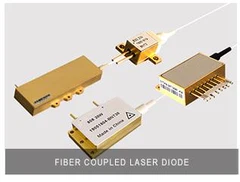
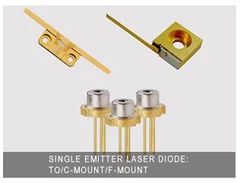


Fiber Coupled Diode Laser use rare earth doped fibers as the active medium, with laser diodes as the pump source, which inherently has some key advantages, making them in the mold through the generation of ultra-short pulse is quite attractive. The high gain bandwidth and efficiency of doped fibers allows the manufacture of relatively inexpensive, compact, rugged fiber laser systems that provide a wide range of fiber-coupled output beams for a wide range of applications.
The fiber provides a high surface area-to-volume ratio, which enables efficient cooling and can be customized according to specific performance parameters. Fiber Coupled Diode Laser are initially limited to continuous (CW), low power, single mode operation. After more than 30 years of development, Fiber Coupled Diode Laser have been able to achieve single and multimode operation, wavelength range covering UV (UV) to far infrared (Far-IR) band, and can provide a very high power level, variable repetition frequency, and (perhaps the most significant) milliseconds to femtosecond pulse width.
Unlike conventional free-space lasers, Fiber Coupled Diode Laser use fiber and fiber Bragg gratings (FBG), which replace conventional dielectric mirrors for optical feedback. Most high-power Fiber Coupled Diode Laser use a double-clad fiber architecture, where the gain medium is in the fiber core, surrounded by two layers of cladding. A multimode pump beam from a laser diode or another fiber laser propagates in the inner cladding and is constrained by the outer cladding to excite the active medium and produce a lasing mode that propagates in the fiber core.
In order to produce ultrafast laser pulses, active or passive mode-locking techniques are required. Some of the techniques used today for passive mode-locking include nonlinear polarization rotation and saturation absorption techniques, while electro-optic or acousto-optic modulators are used for active mode-locking.
In semiconductor saturable absorber (SESAM), semiconductor quantum wells are grown on semiconductor distributed Bragg reflectors, and SESAM has been successfully used to fabricate femtosecond Fiber Coupled Diode Laser operating at 1.0 μm and 1.5 μm wavelengths. The use of erbium-doped (Er) Fiber Coupled Diode Laser using graphene saturable absorbers has shown self-starting mode-locked and stable soliton pulses. These are just a few femtosecond fiber laser architectures that commercial lasers are using to meet a variety of scientific and industrial applications.
Fiber Coupled Diode Laser are an ideal choice for implementing the R / LM2 process because they provide the required high output power (about 800W) and near infrared (NIR) wavelengths, and compared to other types of lasers such as flash Pumped pulsed Nd: YAG lasers, Fiber Coupled Diode Laser have lower operating costs and longer maintenance intervals.
In a single-fiber laser diode-based first-generation fiber laser, a large number of all pump components are usually fused together to achieve maximum stability. Although this method is generally highly robust, it is particularly susceptible to the back reflection from the target material. Therefore, in the treatment of reflective metal, such as copper and brass, you must use some type of optical isolator. In addition, the use of fused components (sometimes including the final transmission fiber) means that these lasers can not be repaired on site. Therefore, if any component is slightly damaged, the entire laser must be returned to the factory for replacement.
Coherent The use of an innovative modular approach to Fiber Coupled Diode Laser is based primarily on semiconductor lasers, rather than single Emitters, as a pump source. The light emitted by the pump linear array is introduced into the gain fiber using a beam combiner composed of discrete optical elements. The beam combiner also calibrates the beam of the gain fiber output, and then the other optical elements are effectively coupled to the final transport fiber.