


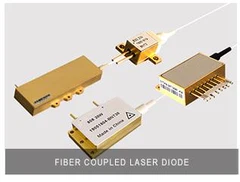
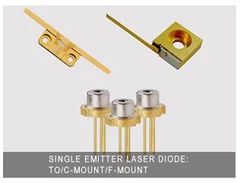


The laser diode is essentially a semiconductor diode. According to whether the PN junction material is the same, the laser diode can be divided into a homojunction, a single heterojunction (SH), a double heterojunction (DH) and a quantum well (QW) laser diode. Quantum well laser diodes have the advantages of low threshold current and high output power, and are the mainstream products in the market. Compared with lasers, laser diodes have the advantages of high efficiency, small size and long life, but their output power is small (generally less than 2mW), linearity and monochromaticity are not good, so their applications in cable TV systems are affected. Very limited, can not transmit multi-channel, high-performance analog signals. In the return module of the bidirectional optical receiver, the uplink transmission generally uses a quantum well laser diode as a light source.
A semiconductor laser diode, a pair of parallel planes perpendicular to the PN junction, forms a Fabry-Perot cavity, which may be the cleavage plane of the semiconductor crystal or a polished plane. The other two sides are relatively rough to eliminate the laser action in other directions in the main direction.
Light emission in semiconductors typically results from the recombination of carriers. When the PN junction of the semiconductor is applied with a forward voltage, the PN junction barrier is weakened, forcing electrons to be injected from the N region through the PN junction into the P region, and holes are injected from the P region through the PN junction into the N region, and these are injected near the PN junction. The equilibrium electrons and holes will recombine to emit photons of wavelength λ, which have the following formula:
λ = hc/Eg (1)
h—Planck constant; c—speed of light; Eg—the forbidden band width of the semiconductor.
The above phenomenon of luminescence due to spontaneous recombination of electrons and holes is called spontaneous emission. When the photons generated by spontaneous emission pass through the semiconductor, once they pass through the emitted electron-hole pairs, they can be excited to recombine and generate new photons, which induce the excited carriers to recombine and emit new photons. The phenomenon is called stimulated radiation. If the injection current is large enough, a carrier distribution opposite to the thermal equilibrium state is formed, that is, the population number is reversed. When the carriers in the active layer are in a large number of reversals, a small amount of spontaneously generated photons generate inductive radiation due to reciprocal reflection at both ends of the resonant cavity, resulting in positive feedback of the frequency selective resonance, or gain for a certain frequency. When the gain is greater than the absorption loss, a coherent light with a good spectral line, the laser, can be emitted from the PN junction, which is the simple principle of the laser diode.