


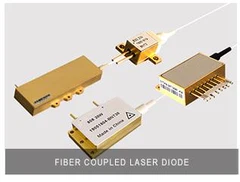
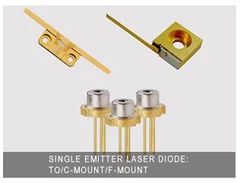


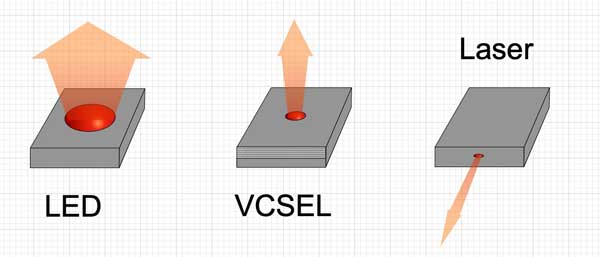
The types of sources used include LEDs, lasers, fabry-perot (F-P) lasers, distributed feedback (DFB) lasers and vertical cavity surface-emitting lasers (VCSELs). All convert electrical signals into optical signals, but are otherwise quite different devices. All three are tiny semiconductor devices (chips) really the size of grains of sand. LEDs and VCSELs are fabricated on semiconductor wafers such that they emit light from the surface of the chip, while f-p and DFB lasers emit from the side of the chip from a laser cavity created in the middle of the chip.
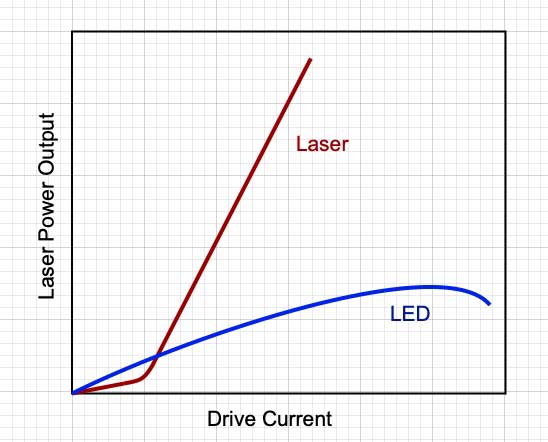
Lasers and LEDs are quite different devices as you can see from this diagram of their light output as a function of drive current. LEDs are simple emitters that generate more light output as the drive current increases until higher currents heats them up and their ligh output decreases, limiting the total power output. Lasers start off like LEDs, generating more light with more drive current, but the light is confined in a small areas in the semiconductor chip called the laser cavity, horizontally inside the chip for most lasers but vertically in a VCSEL Like all lasers, once a certain amount of light is generated inside the laser cavity, the device becomes a "laser" - an acronym for "light amplification by stimulated emission of radiation." Once the device reaches a certain current level, it passes the laser threshold and the light output becomes much higher with little increase in current.
The L-I curves help show why lasers have higher bandwidth than LEDs. LEDs are modulated over higher current ranges to pulse the light output on and off. Lasers are biased at the threshold then modulated with small current changes to get large changes in light output. The smaller size of of lasers also makes them easier to modulate faster. Generally LEDs are limited to several hundred megabits/second links while lasers are good for 25-50 gigabits per second links when direct modulated. (Higher bit rates are possible by having the laser on all the time (CW) and modulating it externally.
LEDs have much lower power outputs than lasers and their larger, diverging light output beam pattern makes them harder to couple into fibers, generally limiting them to use with multimode fibers. LEDs have much less bandwidth than lasers and are limited to systems operating up to about 250 MHz or around 200 Mb/s.
Lasers have smaller tighter light outputs and are easily coupled to singlemode fibers, making them ideal for long distance high speed links. Lasers have very high bandwidth capability, most being useful to well over 10 GHz or 10 Gb/s.
VCSELs are a strange device. They use semiconductor fabrication tricks to create a vertical laser cavity in the chip so the light comes out the top, making it easy to couple into fiber. But the device structure has only been feasible for ~850nm sources, the wavelength used for multimode fiber.
Because of their fabrication methods, LEDs and VCSELs are cheap to make. Lasers are more expensive because creating the laser cavity inside the device is more difficult, The chip must be separated from the semiconductor wafer and each end coated before the laser can even be tested to see if its good.
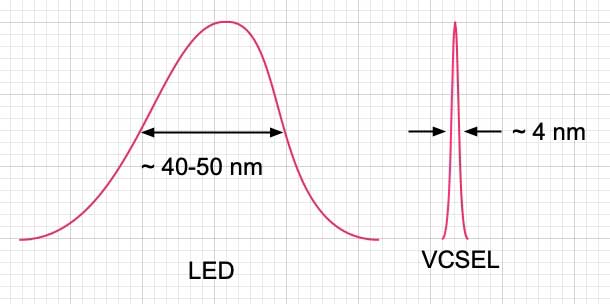
Comparison of spectral output of a LED and a VCSEL, both with a center wavelengh around 850nm.
Another big difference between LEDs and both types of lasers is the spectral output. LEDs have a very broad spectral output which causes them to suffer chromatic dispersion in fiber, while lasers have a narrow spectral output that suffers very little chromatic dispersion. In multimode fiber, the bandwidth of LEDs is highly limited by chromatic dispersion because of its large spectral width (light at longer wavelengths travels faster than light at shorter wavelengths causing dispersion). This adds to VCSELs advantage for higher speed networks.
Welcome contact us for more details:
Whatsapp/Skype/Wechat: 0086 181 5840 0345
Email: info@brandnew-china.com