


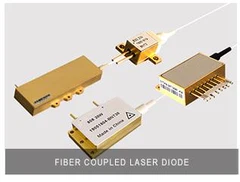
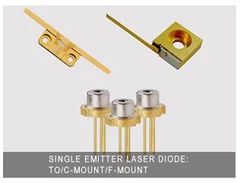


What is the laser diode?
Laser diode (semiconductor laser) is an electronic device that uses semiconductor pn junction to convert current into light energy and generate laser. Laser diode has excellent directivity and straightness. As a light source with easy energy control, it is widely used in optical communication, medical treatment, sensing, data storage, leisure and entertainment. Its basic principle is to use the light generated when electrons and holes recombine.
Laser diodes are also called "semiconductor lasers". "Laser" is the acronym for "Light Amplification by Stimulated Emission of Radiation", which means "stimulated emission of light amplification". Even if the wavelength of natural light and LED light is constant, their phase difference is not constant and the waveform is not uniform. Laser is "coherent" light that only amplifies a specific wavelength. Coherent light sources have a constant phase difference and a consistent waveform, and interference can be used to make the focus very small (a few um~), so they can be used in various applications such as optical switches and optical modulation.
History and Development
The history of laser diodes began in 1917, when Albert Einstein first theorized the phenomenon of "stimulated emission of radiation", laying the foundation for all laser technologies. Later, German John von Neumann described the concept of semiconductor lasers in an unpublished manuscript in 1953. In 1957, American Gordon Gould proposed that stimulated emission of radiation could be used to amplify light, and named it "LASER (Light Amplification by Stimulated Emission of Radiation)". In this way, as scientists from various countries continued to make progress in the research of lasers, the homojunction structure of gallium arsenide (GaAs) semiconductor laser came out in 1962, and coherent light technology was actually verified. In the same year, visible light oscillation was also successful. However, semiconductor lasers of this era had problems with continuous oscillation at room temperature. In 1970, the discovery of double heterostructures made continuous oscillation at room temperature possible. After the 1970s, semiconductor laser technology developed rapidly and was widely used in various fields.
The light-emitting principle of laser diodes
Laser diodes are semiconductor devices that can emit laser light of a specific wavelength. Its basic structure consists of a pn junction composed of a p-type semiconductor and an n-type semiconductor, an active layer that emits light, and a coated mirror that reflects light. The light-emitting principle of laser diodes is that when current flows, electrons and holes recombine, and the radiated photons are amplified in the active layer and reflected in the resonator to form laser light. Let's first understand the basic structure and light-emitting principle of "light-emitting semiconductors" shared by laser diodes and LEDs.

Basic structure and materials of diodes
Semiconductors are materials with conductivity between "conductors" that conduct electricity and "insulators (non-conductors)" that do not conduct electricity easily. Conductors include metal materials such as iron and gold, and insulators include materials such as rubber and glass. Semiconductors can control the flow of electricity by making them conductive or non-conductive. In addition, in some usage methods, energy conversion between light energy and electrical energy can also be performed.
Usually, the components of diodes are mainly made of silicon (Si). Silicon (Si) is the most typical semiconductor material. Silicon exists in nature in the form of "silica (SiO2: stone whose main component is silicon dioxide)" and is a resource-rich material. It is widely used in many semiconductor products because it is easy to process.
Silicon (Si) as a semiconductor material is originally an insulator and has almost no free electrons as carriers. Therefore, by adding other impurities to silicon (Si) to increase the carrier concentration in silicon (Si), its conductivity is increased. Semiconductors that increase carriers by adding impurities like this are called "impurity semiconductors." Carriers include free electrons and free holes. Among them, semiconductors that increase free electron carriers are called "n-type semiconductors", and semiconductors that increase free hole carriers are called "p-type semiconductors."
* p-type semiconductor (+: positive, semiconductor with many holes), n-type semiconductor (-: negative, semiconductor with many electrons)
The element of a diode is a structure in which a p-type semiconductor and an n-type semiconductor are connected, which is called a "pn junction." The pin of a p-type semiconductor is called an "anode", and the pin of an n-type semiconductor is called a "cathode". The current flows from the anode to the cathode.
The principle of diode light emission
When a forward voltage is applied to a pn junction element, holes (positive) and electrons (negative) move toward the junction and combine. The excess energy generated at this time is converted into light energy, thereby achieving light emission. This phenomenon is called "compound light emission".
Laser diodes can be classified according to the direction in which light is emitted.
Edge Emitting Laser (EEL): A structure that uses the cleavage surface of the semiconductor as a reflector to emit light from the cleavage surface.
Surface Emitting Laser (SEL): A structure that emits light vertically from the surface of the semiconductor substrate.
Vertical Cavity Surface Emitting Laser (VCSEL): An optical resonant cavity is formed in the vertical direction of the semiconductor substrate surface, and the emitted laser beam is perpendicular to the substrate surface. It has the characteristics of low threshold current, high-speed modulation with low current, and good temperature stability, and is widely used in optical communications and sensor fields.
These different types of laser diodes have different characteristics and are currently used in a wide variety of applications based on their characteristics.

Life of laser diodes
The average life of laser diodes depends on the operating environment (operating temperature, static electricity, power supply noise, etc.), and it is generally believed that they can be continuously lit for about 10,000 hours under normal conditions (case temperature 25°C). If the operating temperature is high during use, the service life will be shortened, and electrostatic discharge (ESD) can also cause failures. In addition, surges and noise generated by the power supply may also damage the laser element.
In order to use the laser diode for a long time, measures such as heat dissipation measures such as heat sinks, sufficient anti-static and anti-surge measures, the use of noise filters, and controlling the output to the minimum required can effectively extend the service life.
The light emitted by the laser has a high power density. If used improperly, even a small amount of emission may cause harm to the human body, which is very dangerous. Therefore, sufficient safety measures must be taken before use.
Our address
B-1507 Ruiding Mansion,No.200 Zhenhua Rd,Xihu District
Phone Number
0086 181 5840 0345
info@brandnew-china.com
