

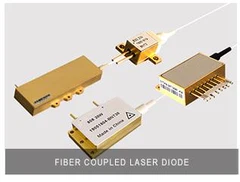
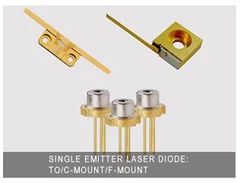


In many applications, it is convenient to couple the output of a laser diode into an optical fiber to deliver the light where it is needed.

Advantages:
The light emitted from the fiber has a round, smooth (homogenized) intensity profile and a symmetrical beam quality, which is very convenient in many cases. For example, less complex optics are required to produce a round pump spot for an end-pumped solid-state laser.
The laser diode can be removed together with its cooling, for example from a solid-state laser head, which can be more compact and leave more space for other parts here.
A defective fiber-coupled diode laser can be easily replaced without changing the alignment of the device using the light.
Fiber-coupled components can be easily combined with other fiber components.
Types of fiber-coupled diode lasers
Many diode lasers are sold in fiber-coupled form, with robust fiber-coupling optics built into the laser package (e.g., permanent laser welding fiber attachment). The fibers and technologies used for different diode lasers vary greatly:
The simplest case is the VCSEL (Vertical Cavity Surface Emitting Laser), which typically emits a beam with high beam quality, moderate beam divergence, no astigmatism and a circular intensity distribution. A simple spherical lens is sufficient for imaging the emission point into the core of a single-mode fiber. Coupling efficiencies of the order of 70-80% can be achieved. It is also possible to couple (butt-joint) the fiber directly to the emitting surface of the VCSEL.
Small edge-emitting laser diodes also emit in a single spatial mode and thus in principle also allow efficient coupling to single-mode fibers. However, if a simple spherical lens is used, the coupling efficiency is significantly reduced by the ellipticity of the beam. Furthermore, the beam divergence is relatively high in at least one direction, requiring lenses with relatively high numerical aperture. Another problem is the astigmatism of the diode output, especially for gain-guided diodes; this can be compensated by additional weak cylindrical lenses. With output powers up to a few hundred milliwatts, fiber-coupled gain-guided LDs can be used to pump, for example, erbium-doped fiber amplifiers.

Schematic setup of a simple fiber-coupled low-power edge-emitting laser diode. A spherical lens (or possibly a double lens) is used to image the laser diode facet into the fiber core. Beam ellipticity and astigmatism reduce coupling efficiency.
Wide-area laser diodes are spatially multimode in the long direction of the emitter. If the round beam is simply shaped with a cylindrical lens and then launched into a multimode fiber, much of the brightness (radiance) will be lost because the high beam quality in the fast axis direction cannot be exploited. For example, 1 W of power can be launched into a multimode fiber with a core diameter of 50 μm and a numerical aperture (NA) of 0.12. This is sufficient to pump low-power bulk lasers, such as microchip lasers. Even launched powers of 10 W are possible.

Schematic setup of a simple fiber-coupled wide-area laser diode. A fiber lens is used to collimate the beam in the fast axis direction.
An improved wide-area laser technology is based on shaping the beam before launch to obtain a symmetric beam quality (not just a symmetric beam radius). This allows for higher brightness.
For diode bars (diode arrays), the problem of asymmetric beam quality is even more severe. Here, the outputs of the individual emitters can be coupled into separate fibers of a fiber bundle. The fibers are arranged in a linear array on one side of the diode bar, but in a circular array on the output end. Alternatively, some kind of beam shaper can be used to make the beam quality symmetrical before launching into a single multimode fiber. This can be done, for example, with a two-mirror beam shaper or some micro-optics. For example, 30 W can be coupled into a fiber with a core diameter of 200-μm (or even 100-μm) and an NA of 0.22. Such a setup can be used, for example, to pump Nd:YAG or Nd:YVO 4 lasers with an output power of about 15 W.
For the diode stack, fibers with a larger core diameter are used. For example, hundreds of watts (or even kilowatts) of optical power can be coupled into a fiber with a core diameter of 600 μm and an NA = 0.22.
Disadvantages of fiber coupling
Some potential disadvantages of fiber-coupled diode lasers compared to free-space emitting lasers are:
Higher cost. However, this may be offset by the savings gained from simpler beam handling and delivery.
Output power is slightly reduced, and more importantly, radiance. The radiance loss may be large (over an order of magnitude) or quite small, depending on the fiber coupling technique. In some cases this may not be a problem, but in others it introduces significant challenges such as for designing a diode-pumped bulk laser or high-power fiber laser.
In most cases (especially multimode fibers), the fiber is not polarization-maintaining. The fiber output will typically be partially polarized, and the polarization state will change when the fiber is moved or when the temperature changes. This can lead to serious stability problems for diode-pumped solid-state lasers when the pump absorption is polarization-dependent (such as in Nd:YVO 4 ).
Fiber-coupled laser diode products may also not be available for every optical wavelength.
Fiber Output Beam Quality
The beam quality of the fiber output is usually not specified; in many cases only the core diameter and numerical aperture (NA) are known, and a step-index multimode fiber is assumed. In this case, there is no formula to calculate the beam quality exactly, since it depends on the optical power distribution over the fiber modes, which itself depends on the launch conditions. However, the beam quality factor M2 can be roughly estimated, assuming that the power is well distributed over the modes and therefore the numerical aperture represents a reasonable estimate of the actual beam divergence (which may be slightly higher). This leads to the equation M2≈(πα/λ)ΝΑ, where a is the fiber core radius (i.e., half the core diameter). The beam quality can also be significantly improved if the light is launched predominantly in low-order guided fiber modes, but it may be degraded by strong bending of the fiber.
Our address
B-1507 Ruiding Mansion,No.200 Zhenhua Rd,Xihu District
Phone Number
0086 181 5840 0345
info@brandnew-china.com