

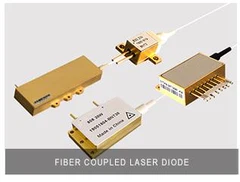
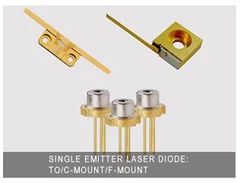


How Next-Gen Lasers are Redefining the Boundaries of Industrial Efficiency?
Once localized to specialized physics laboratories, the laser-celebrated as "the sharpest knife, the most precise ruler, and the brightest light"-has completely cross-pollinated into the structural bedrock of modern global industry.
As manufacturing paradigms shift toward structural miniaturization, aggressive carbon neutrality targets, and total automation, specialized semiconductor and solid-state laser sources have evolved from optional upgrades into high-priority core components.The global photonics market is no longer just expanding; it is diversifying.
By leveraging distinct material absorption rates across a wide spectral range (405nm to 1653nm), manufacturers are deploying highly tailored wavelengths to bypass the thermal and physical bottlenecks that have long constrained traditional machinery.
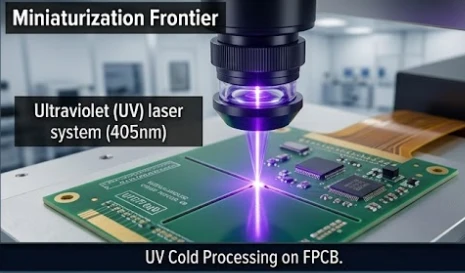
The Miniaturization Frontier:Submicron Manufacturing and Semiconductor Packaging
The relentless consumer demand for thinner electronics, higher semiconductor logic densities, and ultra-dense circuit layouts has pushed mechanical tooling past its physical limits. Photon-based processing has stepped in as the absolute standard for clean, submicron micro-machining.
At the absolute forefront of this shift are Ultraviolet (UV) lasers (355nm / 405nm). Operating via "cold processing," these wavelengths break molecular bonds directly rather than relying on intense localized heat. This lack of thermal dispersion is critical for scribing sensitive OLED displays, trimming microchips, and dicing delicate silicon wafers without introducing micro-cracks or material warping.
Simultaneously, the integration of 940nm Vertical-Cavity Surface-Emitting Laser (VCSEL) arrays within mobile and smart devices has reached unprecedented economies of scale. Serving as the compact illumination engines for 3D facial recognition and proximity sensing, these high-reliability chip arrays have established a permanent, high-volume baseline in the international optoelectronics component supply chain.
The Clean-Energy and Decarbonization Catalysts
Beyond electronics, laser systems have become instrumental in fulfilling global environmental mandates, acting both as high-power production tools for green infrastructure and as ultra-precise environmental sentinels.
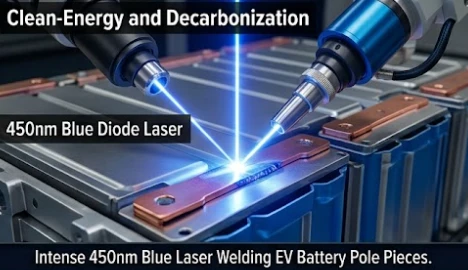
In the electric vehicle (EV) sector, the processing of highly reflective metals like copper and aluminum has historically presented a severe industrial challenge due to poor infrared absorption. The industrialization of visible blue and green lasers (450nm / 520nm) has completely overturned this limitation. Because copper absorbs blue laser light at a rate multiple times higher than standard infrared wavelengths, blue diode lasers have become the absolute mainstream configuration for high-speed, spatter-free welding of EV battery cell pole pieces.
Outside the factory floor, the focus shifts to climate monitoring grids. Distributed Feedback (DFB) lasers operating in the 1530nm to 1654nm band are uniquely engineered to align with the primary gas absorption cross-sections of Methane ($\text{CH}_4$), Carbon Monoxide ($\text{CO}$), and Carbon Dioxide ($\text{CO}_2$). These narrow-linewidth infrared sources now power real-time vehicle exhaust diagnostics, urban emission tracking arrays, and early-warning industrial gas sensors, seeing aggressive procurement across European and Middle Eastern environmental engineering networks.
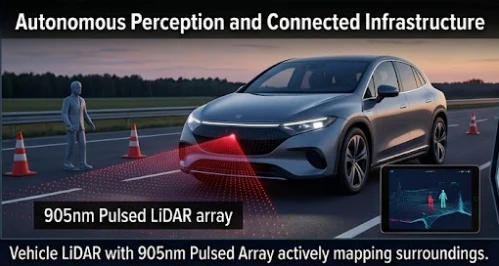
Autonomous Perception and Hyper-Connected Infrastructure
The concept of smart cities and intelligent mobility relies entirely on capturing and transmitting vast amounts of real-time spatial data. Here, optoelectronics provide both the sensory "eyes" and the optical "highways."
For spatial perception, 905nm pulsed laser diode arrays have emerged as the dominant, cost-efficient transmitter architecture for automotive-grade LiDAR. These arrays enable advanced driver-assistance systems (ADAS) and autonomous vehicles to map complex surroundings, classify obstacles, and manage pedestrian safety in real time. On a smaller scale, compact 905nm variants are deeply integrated into factory Automated Guided Vehicles (AGVs), highway traffic stream profiling scanners, and industrial material level telemetry.
Once data is captured, it must be transmitted instantly. Continuous-wave (CW) DFB communication lasers at 1310nm and 1550nm serve as the underlying emission chips within high-speed optical transceivers. These highly stable, low-noise components form the backbone of hyper-scale data centers and global fiber-optic networks, supporting the massive data surges brought on by global digital transformation.
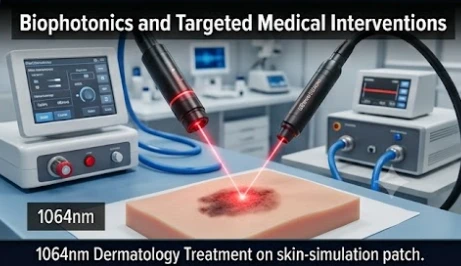
Biophotonics and Targeted Medical Interventions
Modern medical technology increasingly leverages the specific optical signatures of human tissue to replace traditional scalpels with targeted photon streams, drastically reducing patient recovery windows and procedural risks.
In clinical settings, 405nm blue outputs provide incredibly clean, localized soft-tissue incisions for dental surgeries, while advanced fiber-coupled infrared lasers are utilized via endoscopes for targeted photodynamic tumor destruction and non-invasive ophthalmic retinal photocoagulation.
Meanwhile, the aesthetics and dermatology sector relies heavily on the 808nm diode laser-widely regarded as the global gold standard for deep, permanent hair removal-alongside 1064nm infrared laser modules optimized to break down deep vascular lesions and subdermal pigments without damaging the surrounding skin. Furthermore, ultra-stable, narrow-linewidth sources are revitalizing biomedical sensing, acting as the foundation for Optical Coherence Tomography (OCT) systems that unlock non-contact eye-fundus mapping and rapid cell-counting diagnostics.
Our address
RM1705, Building 2, Aoqiang Mansion, No. 6 Xiyuan 5th Rd
Whatsapp/Wechat
+ 86 181 5840 0345
wp@brandnew-china.com