


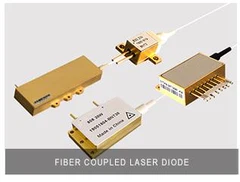
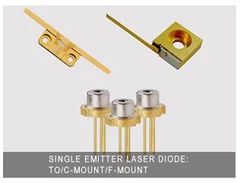


Higher power, shorter pulses, and stronger brightness are the constant pursuit of laser technology development. In the industrial application of pulsed lasers, short pulses and high peak values have an important impact on the material processing effect. Compared with solid-state lasers, fiber lasers have more advantages in average power, but are significantly limited in peak power. For a long time, the pulse width of fiber pulse lasers has been limited to more than ns, with a peak value of less than 15kW, and a standard of 100ns 1mJ.
Methods to increase pulse peak power
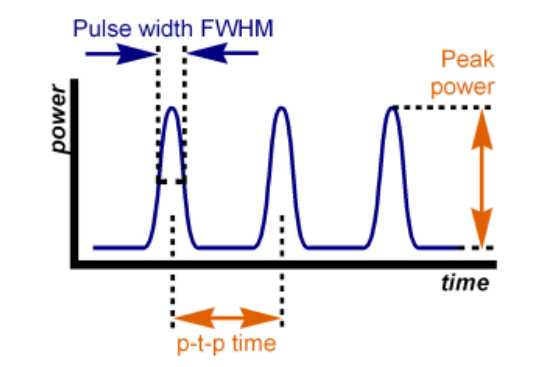
In the laser pulse sequence shown in FIG1 , the peak power is equal to the pulse energy divided by the pulse width. Therefore, under the same energy conditions, shortening the pulse width can greatly increase the peak power. Under the same pulse width conditions, increasing the peak value can increase the pulse energy.
Among the solid pulse lasers currently on the mainstream industrial market, the energy of nanosecond pulse width lasers can reach the mJ level. Calculated at 1mJ energy and 10ns pulse width, the peak power can reach 100kW. The energy of picosecond pulse lasers is around 300μJ. Calculated at 10ps, the peak power can reach 30MW. The energy of femtosecond pulse lasers is 100μJ and the pulse width is 500fs, so the peak power reaches 200MW. In comparison, the peak power of conventional MOPA nanosecond pulse lasers is around 10kW, which is far lower than the indicators of solid lasers.
Limiting factors in increasing fiber pulse peak power
The main limiting factors include five items: limited load capacity, limited B integral, limited extraction efficiency, limited beam quality and limited polarization state. At the same time, the various physical mechanism solutions given belong to different design levels, including: matrix material, increased mode field, guided mode structure and polarization structure belong to the fiber design level; end cap beam expansion, mode excitation, mode filtering belong to the device design level; pumping mode, isolation filtering and polarization control belong to the unit design level; increased bandwidth, pulse width selection, repetition frequency selection and gain allocation belong to the system design level.
In addition to the above five items, the thermal effects that need to be considered in continuous high-power fiber lasers are not listed here, because the average power of the high peak power fiber amplifier we pursue is far lower than the scope where the thermal effect can play a significant role, so it will not be discussed here.
The load capacity is limited by the laser intensity. The physical mechanism includes body damage and surface damage. Among them, surface damage can be avoided by end capping technology, and body damage is limited by the characteristics of the fiber matrix material, which is the limit limiting factor. Typically, the light intensity threshold is about 4.75kW/μm2. For a mode field diameter of 50μm, the corresponding damage power threshold reaches 9.3MW, which is far higher than the current peak power level of the pulse fiber laser core and higher than the self-focusing threshold power. Therefore, body damage is not a problem that needs to be considered at present.
The extraction efficiency is mainly limited by the amplification of spontaneous emission (ASE), the gain distribution of the multi-stage amplifier, and the duty cycle of the pulse within the stage. Especially under the condition of sub-nanosecond short pulse amplification, ASE directly limits the increase of pulse energy and peak power. However, the limitation of ASE can be suppressed by rationally designing multi-stage amplifiers, optimizing inter-stage gain distribution and pumping methods, and reducing the ASE component transmitted to the subsequent stage by spectral filtering and acousto-optic filtering. Reasonable inter-stage gain distribution can also help suppress pulse gain saturation problems and obtain more perfect pulse waveforms.
The beam quality is limited and measured by the beam quality factor M2. To obtain the fundamental mode output, the main thing is to ensure single-mode or few-mode operation through the design of the optical waveguide mode structure. On this basis, the mode excitation control during the fusion of different core diameter fibers and mode filtering methods such as fiber winding are used to improve the beam quality. At present, the conventional optical fiber that can guarantee high beam quality output is 30/250, and the core of special optical fibers such as photonic crystals can be expanded to about 100μm. This mode field size is still too small compared to the millimeter-level spot size of industrial solid-state lasers. Many nonlinear effects mentioned later are related to the B integral, which is inversely proportional to the mode field area.
The polarization state is limited and measured by the degree of polarization. The physical mechanism is mainly the polarization characteristics of the optical fiber waveguide. In ordinary double-clad optical fibers, linearly polarized light will depolarize, and the degree of depolarization is sensitive to bending and environmental parameters, making it difficult to maintain a stable polarization state output. Under the same conditions, the peak power threshold of polarized light is generally half that of non-polarized light, because non-polarized light can be decomposed into two orthogonal non-polarized light components.
The third-order nonlinear effects in optical fibers can be divided into two categories: one is the refractive index modulation effect induced by light intensity, including self-phase modulation (SPM), cross-phase modulation (XPM), modulation instability (MI), four-wave mixing (FWM) and self-focusing (SF); the other is the inelastic light scattering effect, which involves the energy exchange between photons and the lattice vibration of the matrix material, including stimulated Brillouin scattering (SBS) and stimulated Raman scattering (SRS).
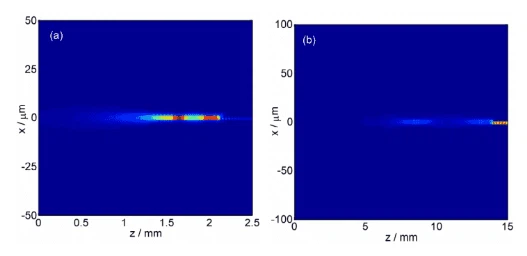
Among them, the highest limit depends on the self-focusing threshold, which is about 4MW for optical fiber materials. Below the self-focusing threshold, stimulated Raman scattering is the most important limitation, because the spectral frequency shift of Raman light compared to the fundamental frequency light is as high as 60nm. Too high Raman components will seriously affect the function of the isolator magneto-optical crystal and will also cause great chromatic aberration to the lens. Figure shows the evolution of self-focusing filamentation generated when the peak power in the optical fiber exceeds the self-focusing threshold.
Our address
B-1507 Ruiding Mansion,No.200 Zhenhua Rd,Xihu District
Phone Number
0086 181 5840 0345
info@brandnew-china.com
