


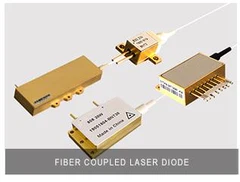
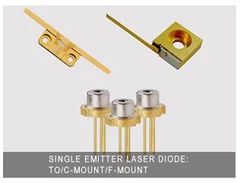


The most basic function of an optical module is to complete the optical-electrical/electrical-optical conversion function of optical signals, and its interior is composed of optical devices, functional circuits, and optical interfaces. The optical device is the main component of the optical module, and the optical module adds some functional circuits and structural components based on the optical device.
Let's start with the optical devices of the optical module. Among the optical devices of the optical module, the optical devices used for optical signal conversion are called TOSA and ROSA respectively. Let's introduce them in detail.
The main component of the TOSA (Transmitting Optical Sub-Assembley) optical transmitter module mainly completes the conversion of electrical signals into optical signals. Among them, the light source (semiconductor light-emitting diode or laser diode) is the core, LD chip, monitor photodiode (MD) and other components are packaged in a compact structure (TO coaxial package or butterfly package), and then TOSA is formed.
In TOSA, LD laser diode is currently the most commonly used semiconductor emitting device for optical modules. It has two main parameters: threshold current (Ith) and slope efficiency (S). In order to make the LD work quickly, we must provide the LD with a DC bias current IBIAS slightly greater than the threshold current (DC Bias in the figure above), that is, the laser is emitted when the forward current exceeds the threshold current.
ROSA (Resceiving Optical Sub-Assembly) optical receiving assembly, in the high data rate optical fiber module, usually PIN or ADP photodiode and TIA are assembled in a sealed metal casing to form our optical receiving assembly.
The optical module ROSA is composed of a photodetector (PIN/APD), a TIA preamplifier, a limiting amplifier, etc.
Let's first look at the photodetector, the main device of the receiving component ROSA (the photodetector used in the above figure is APD), whose main function is to convert optical signals into electronic signals through the photoelectric effect. Common photodetectors in optical communications are PIN photodiodes and avalanche photodiodes (APDs). As we mentioned in previous articles, APDs are a high-sensitivity photodetector that uses the avalanche multiplication effect to increase the photocurrent Double, compared with PIN photodiodes, APD receiver sensitivity can be increased by 6~10dB.
The weak signal current generated by the photodetector is converted into a signal voltage of sufficient magnitude by the preamplifier TIA (Trans-Impedance Amplifier), and then output. TIA is actually a V converter, which converts electro-optic current into voltage.
At this time, the voltage signal produced by TIA is still an analog signal, which needs to be converted into a digital signal before the signal processing circuit can recognize it. The function of the limiting amplifier Poster Amplifier behind the TIA is to convert signals of different amplitudes into digital signals with the same amplitude.

Welcome contact us for more details:
Whatsapp/Skype/Wechat: 0086 181 5840 0345
Email: info@brandnew-china.com