


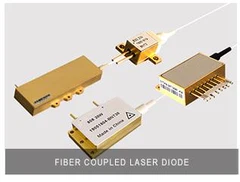
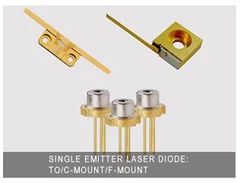


There are many different types of lasers and below are the five major types.
1. Gas lasers – ex. HeNe gas laser, and CO2 lasers which emit hundreds of watts of power. They are usually used for cutting and welding in industries.
2. Chemical lasers – powered by chemical reaction which permits large amount of energy, mainly for military use and of very high wavelength. Ex. Hydrogen fluoride laser 2700nm.
3. Solid-state lasers – optically pumped through use of solid medium that is doped , such as ion doped crystalline or glass. An example would be a laser pointer.
4. Fiber lasers – light is guided due to internal reflection in optical fiber. They are widely known nowadays for their high output power and high optical quality as well as long lifespan. The reason is due to the properties of fibers that give high surface area to volume ratio, which allows for efficient cooling when supporting kilowatts of continuous output power. Fiber's wave-guiding properties help maintain signal strength and minimize distortion. Fiber lasers are widely used nowadays for telecommunication that spread across regions several kilometers long.
5. Semiconductor lasers – electrically pumped
a) Light-emitting diodes (LEDs) - In a diode formed from a direct bandgap semiconductor, such as gallium arsenide, carriers that cross the junction emit photons when they recombine with the majority carrier on the other side. Depending on the material, wavelengths (or colors) from the infrared to the near ultraviolet may be produced. All LEDs produce incoherent, narrow-spectrum light. LEDs can also be used as low-efficiency photodiodes in signal applications. An LED may be paired with a photodiode or phototransistor in the same package, to form an opto-isolator.
b) Laser diodes - When an LED-like structure is contained in a resonant cavity formed by polishing the parallel end faces, a laser can be formed. Laser diodes are commonly used in optical storage devices and for high speed optical communication.
Laser diode is a laser where the medium is a semiconductor, formed by a p-n junction, as shown in Fig. 3, and powered by electric current. For different types of laser diode structures, please refer to Appendix 3. Basically, a laser diode is a combination of semiconductor chip that emits coherent light and a monitor photodiode chip for feedback control of power output, in a hermetically packaged and sealed case. The semiconductor materials that are used to create p-n junction diodes that emit light today are: Gallium arsenide, indium phosphide, gallium antimonide, and gallium nitride. The reason that these are being used is because of the three-five compound properties on chemical periodic table. The materials have to be heavily doped to create P – N regions, which rules out others, leaving groups three-five the ideal options.

Our address
B-1508 Ruiding Mansion,No.200 Zhenhua Rd,Xihu District
Phone Number
0086 181 5840 0345
info@brandnew-china.com
