

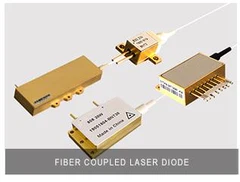
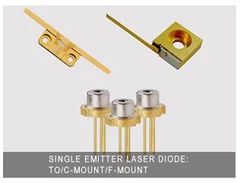


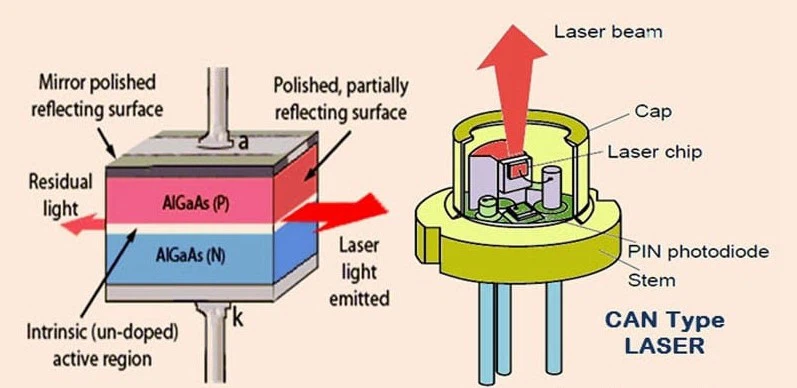
Laser diodes are semiconductor devices that emit coherent light through the process of stimulated emission. The construction of a laser diode is similar to that of a light-emitting diode (LED), but with several key differences. Laser diodes have an active region that is made of a thin layer of material, such as Gallium Arsenide (GaAs), with a higher refractive index than the surrounding layers. This active region is sandwiched between two layers of p-type and n-type semiconductors.
01
Wavelength
The wavelength of light emitted by the laser diode. For a single-mode device, this is the wavelength of the single spectral line of the laser output. For a multimode device, this is the wavelength of the spectral line with the greatest intensity
02
Output Power
Maximum allowable instantaneous optical power output in either continuous or pulse operation.
03
Operating current
The amount of forward current through the laser diode necessary to produce the specified typical optical output at a specified operating temperature.
04
Operating voltage
The forward voltage across the laser diode when the device produces its specified typical optical output at a specified operating temperature.

When a voltage is applied across the p-n junction, electrons and holes are injected into the active region. These electrons and holes combine to create electron-hole pairs, which release energy in the form of photons via a process known as spontaneous emission. However, without the presence of a small amount of light, the photons produced are not coherent.
To produce a coherent beam of light, a feedback loop must be created. This is achieved by adding two parallel mirrors to the semiconductor structure, one of which is partially reflective. When light is produced in the active region, it bounces between the two mirrors until a certain threshold is reached, and then the photons escape via the partially reflective mirror as a coherent beam of light.
Laser diodes have several advantages over other types of lasers. They are compact, efficient, and relatively inexpensive to manufacture. They can also operate at high speeds and wavelengths, making them ideal for telecommunications and sensing applications.
In conclusion, laser diodes are semiconductor devices that produce coherent light through the process of stimulated emission. They are widely used in various applications and have several advantages over other types of lasers. Their compact size, efficiency, and relatively low cost make them particularly suitable for mass production and use in consumer products.
Our address
B-1508 Ruiding Mansion,No.200 Zhenhua Rd,Xihu District,Hangzhou,China
Phone Number
0086 181 5840 0345
info@brandnew-china.com